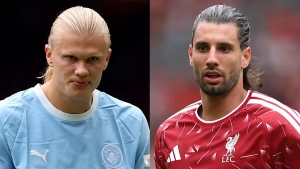
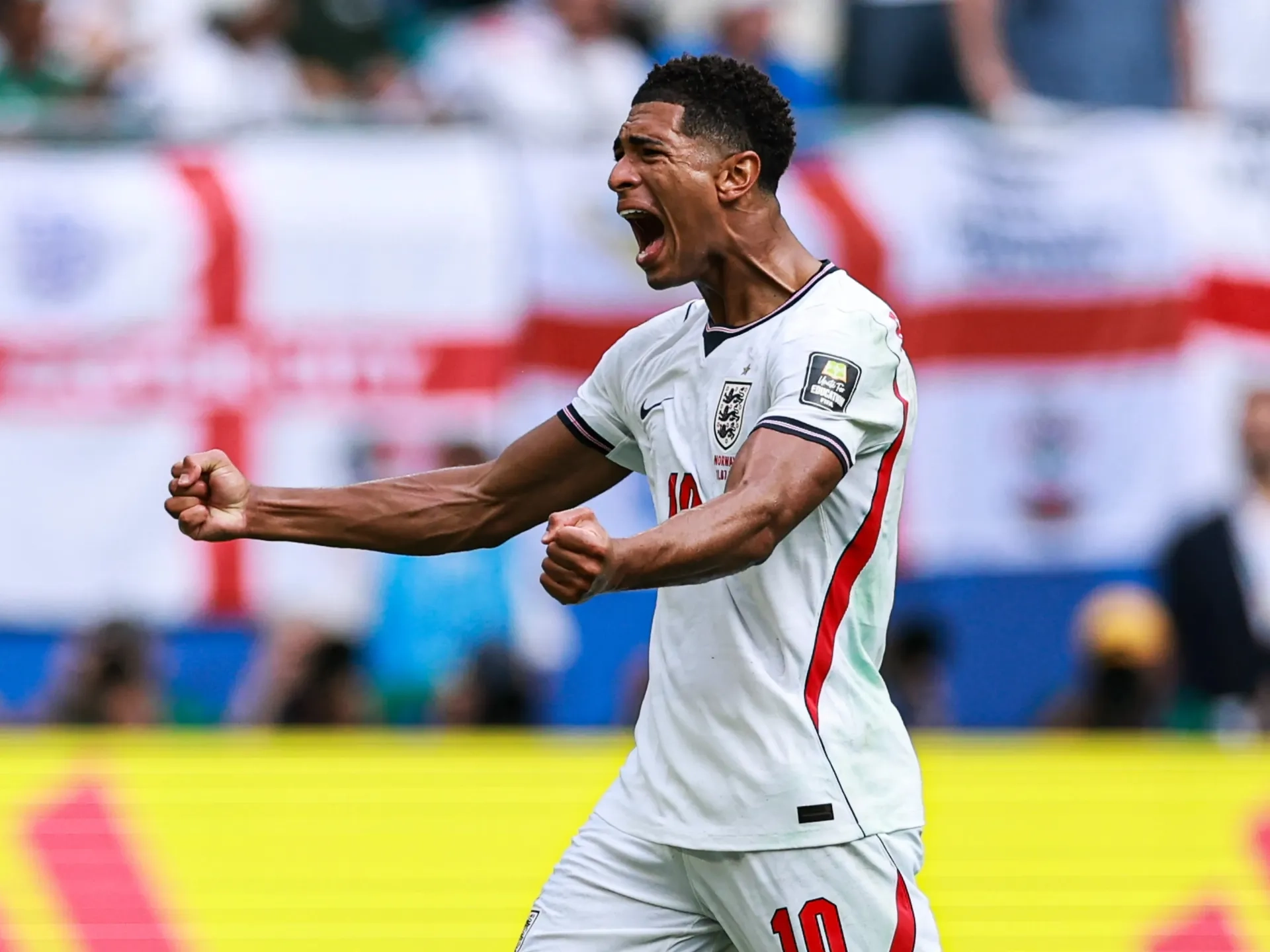
England are in the World Cup semi-finals for the first time since Italia 1990 — and the man who put them there did so in the manner that has defined England’s entire 2026 tournament: a moment of individual brilliance, delivered under maximum pressure, at the latest possible moment. Jude Bellingham’s second goal of the evening in the 93rd minute of extra time — a first-time slide underneath the diving Ørjan Nyland from a Saka cross — completed a 2-1 AET victory over Norway at Hard Rock Stadium in Miami that was as draining, dramatic, and ultimately triumphant as any match England have played since the 1966 final.
Andreas Schjelderup had given Norway a deserved 36th-minute lead with a magnificent curling effort. Bellingham had equalised in first-half stoppage time with a poacher’s finish. A VAR-cancelled Sørloth goal had kept the match alive through a bruising second half. And then, with Haaland forced off injured in the 105th minute and Norway launching desperate aerial bombardments in the dying stages of extra time, England held on. Six tournament goals for Bellingham. A World Cup semi-final against Argentina or Switzerland in Atlanta on Wednesday. And sixty years of hurt still in the memory — but suddenly feeling conquerable. For football fans across Kenya and the African continent who have watched this tournament with total absorption, this was the night England proved they can go all the way.
📊 England vs Norway — 2026 World Cup Quarter-Final Match Stats
- Final Score: England 2-1 Norway (AET)
- Venue: Hard Rock Stadium, Miami, USA — July 12, 2026
- Goals: Schjelderup (36′), Bellingham (47′), Bellingham (93′)
- VAR cancellation: Sørloth goal disallowed (56′) — marginal offside
- Haaland: Forced off injured in the 105th minute — replaced by Strand Larsen
- Key Norway miss: Bobb shot over the bar (114′) — point-blank from penalty spot
- Bellingham 2026 WC tally: 6 goals in 6 appearances
- England semi-final: vs Argentina or Switzerland — Atlanta, Wednesday July 15
- Last England WC semi-final: Italia 1990 — 36 years ago
England in the Semi-Finals: Bellingham Delivers the Defining Moment Again
The pattern of this England World Cup campaign has been established across six matches and multiple knockout rounds: when the moment demands the most, when the pressure is highest and the options are narrowest, Jude Bellingham produces the answer. The Panama free-kick. The DR Congo dead-ball goal. The double against Mexico at the Azteca. And now this — a brace in a quarter-final against Norway that included an extra-time winner of the type that is replayed for decades.
England’s 2-1 extra-time victory in Miami was not comfortable. It was not flowing. It was not the kind of performance that will generate tactical admiration from neutral observers. It was grinding, physical, emotionally exhausting football — exactly the kind of match that tests a squad’s psychological depth as much as its technical quality. Norway were not merely opponents to be defeated; they were a side that believed, for large portions of the match, that they were going to win. Their structural game plan worked perfectly for the opening 36 minutes. Their defensive organisation kept England out for long stretches of the second half. And even with Haaland forced off in extra time, they pushed England to the edge before Bellingham’s winners held.
The result: England’s first World Cup semi-final since 1990. A generation of supporters who have lived their entire football-watching lives without this moment finally have it. And four days between them and a potential World Cup final.
Schjelderup’s 36th-Minute Curler: Norway Execute Solbakken’s Game Plan to Perfection
Ståle Solbakken set Norway up in a fluid 4-1-2-3 block specifically designed to disrupt England’s central passing lanes — using the blistering wide recovery pace of Julian Ryerson and David Møller Wolfe to contain Madueke and Gordon, while pushing Martin Ødegaard into a deep-lying role from which he could spray long-range distributions to wide areas before England’s midfield press could organise.
For the opening thirty minutes, the system functioned with remarkable effectiveness. Ødegaard operated with typical elegance — dropping deep to evade Declan Rice before finding his wide targets with pinpoint long-range passing that bypassed England’s high defensive line entirely. England were uncomfortable. Their transition speed was insufficient to cope with the directness of Norway’s counters. And when the breakthrough arrived in the 36th minute, it was entirely consistent with Norway’s attacking game plan.
Following a central interception by Sander Berge — winning the physical midfield duel that Solbakken had designed his entire system around — the ball shifted quickly to the left wing. Andreas Schjelderup latched onto the pass with the confidence of a player who had been causing problems all evening, jinked inside past Ezri Konsa with a sharp directional change, and unleashed a magnificent curling right-footed strike into the far corner — completely out of Jordan Pickford’s reach. 1-0 Norway. The Miami crowd was silenced. England’s composure was tested.
Bellingham’s 47th-Minute Poacher’s Goal: England Rescued Right Before the Whistle
The psychological impact of Schjelderup’s goal was visible immediately. England — already navigating the defensive problems created by their right-back injury crisis and the absence of the full Guehi-Konsa partnership in its most settled form — looked momentarily unravelled, struggling with transition speed and making uncharacteristic errors under the humid Florida conditions. For a brief period, the quarter-final appeared to be following the Norway script precisely.
Then came the corner. In the 47th minute, deep into first-half stoppage time, England sustained a period of heavy aerial pressure from a set piece that Norway’s defensive block had been absorbing but not fully clearing. A loose clearance from the corner bounced directly to the edge of the six-yard box — the kind of second-ball situation that requires both positioning and instinct from an arriving midfielder.
Jude Bellingham had both. Reading the trajectory of the loose ball with lightning anticipation, he arrived precisely at the right moment — right foot, minimal backlift, clinical direction — and prodded a poacher’s finish past Ørjan Nyland before the goalkeeper had time to set himself. 1-1. The England players erupted. The Miami stadium erupted in turn. And thirty seconds later, the referee’s whistle sent both teams into the interval level — the worst possible outcome for Norway, who had been so close to a half-time lead.
How many goals has Bellingham scored at the 2026 World Cup?
Jude Bellingham’s two goals against Norway brought his 2026 World Cup tally to six goals in six appearances — making him the joint-highest English scorer at a single World Cup in the tournament’s history. His tournament has been defined by the ability to produce decisive moments at the most critical junctures: Panama free-kick, DR Congo dead ball, two goals at the Azteca, and now a brace in extra time against Norway to send England to the semi-finals.
Second Half: VAR Denies Norway, Saka and Eze Change the Game & the Attrition Battle
Tuchel’s half-time adjustments demonstrated exactly the tactical awareness that the situation demanded. Introducing Bukayo Saka and Eberechi Eze to stretch Norway’s horizontal defensive lines gave England the wide creativity that had been absent in a first half dominated by Norway’s transition play. Saka’s runs down the right generated crossing positions. Eze’s intelligent movement between the lines offered progressive passing options that Rice and Anderson had been denied in the opening period.
The adjustments initially yielded results — England created clearer opportunities in the opening twenty minutes of the second half than they had managed across the entire first forty-five. But Norway’s central defensive partnership of Kristoffer Ajer and Torbjørn Heggem marshalled the penalty area with the composed, physical excellence that Solbakken had always trusted them to provide in the tournament’s most demanding matches.
The match’s most dramatic moment — and the one that ultimately shaped the remaining sixty-plus minutes — arrived in the 56th minute. Alexander Sørloth connected with an Ødegaard cross to slot home what appeared to be a sensational second goal for Norway — a finish that, had it stood, would have put England in the most precarious position of their entire tournament campaign. The Scandinavian supporters erupted. Norway’s players sprinted toward the corner flag.
A lengthy VAR intervention extinguished the celebration. The review confirmed a marginal offside in the build-up phase — so fine that multiple replays were required to establish it beyond doubt. The goal was cancelled. The score remained 1-1. And Norway, deflated by the reversal, had to absorb the psychological impact of having a goal taken away while also managing the physical demands of a match that was entering its most gruelling phase.
Solbakken responded by sending on Oscar Bobb and Antonio Nusa — immediately finding attacking momentum through Nusa’s direct running and Bobb’s intelligent positioning. Nusa forced Reece James — back in the starting lineup and providing exactly the right-flank quality that Tuchel needed — into an intensive defensive workout. But a combination of brilliant covering blocks from John Stones and Dan Burn kept the score at 1-1 through ninety minutes and into extra time.
Extra Time: Bellingham’s 93rd-Minute Dagger & Haaland’s Heartbreaking Exit
Thirty additional minutes of high-stakes knockout football — in Florida heat, after ninety of the most physically and emotionally demanding minutes that either squad had experienced at this tournament. Both sets of players were visibly exhausted. Both coaching staffs were managing the edge of what human physical capacity can sustain. And in this context, with the margin between a World Cup semi-final and elimination reduced to the thinnest possible edge, Jude Bellingham did what Jude Bellingham does.
The definitive moment arrived in the 93rd minute — less than three minutes into the extra period. Bukayo Saka picked up a loose ball on the right wing and manufactured a low, driven cross into a crowded Norway penalty box with the technical precision that characterises his best creative moments. The delivery was perfectly weighted — arriving at exactly the pace and height that made a first-time finish the optimum response.
Bellingham had already started his run before the cross left Saka’s foot — reading the trajectory, timing the diagonal, arriving at the back post with the momentum and positioning to slide a first-time finish underneath a diving Nyland. The ball crossed the line. The England bench erupted. And in a Hard Rock Stadium packed with thousands of supporters who had crossed the Atlantic for exactly this moment, the noise was like nothing heard at a football match in decades.
The match’s most heartbreaking subplot unfolded in the 105th minute. Erling Haaland — who had driven Norway through this tournament with seven goals and an emotional intensity that captured the imagination of every football fan watching — went down with a physical knock and was unable to continue. He was replaced by Jørgen Strand Larsen. Without their ultimate offensive weapon, Norway launched a frantic, emotionally driven final bombardment.
The drama peaked in the 114th minute. Antonio Nusa drove a dangerous cross into the box that took a wicked, unpredictable deflection. The ball dropped perfectly onto the penalty spot for Oscar Bobb — a seemingly certain equaliser. The young midfielder, under heavy pressure from two converging England defenders, leaned back and fired his shot over the crossbar. The sound of the ball clearing the bar echoed around the stadium with the most relieving resonance England supporters will ever know.
Pickford flew off his line to punch an incoming free-kick clear, colliding with Guehi and triggering a furious protest from Ajer — earning a yellow card for dissent that underlined the emotional extremity of Norway’s final desperate effort. Dan Burn headed away the last long balls. The clock ran down. The final whistle came. England had survived.
Haaland’s Historic Debut: The Opening Chapter of a World Cup Legend
In the immediate aftermath of England’s progression, it would be easy to overlook what Erling Haaland has contributed to this World Cup tournament — both for Norway and for the broader narrative of a competition that has been enriched by his extraordinary debut campaign.
Haaland exits the 2026 World Cup with seven goals in four appearances — the most prolific debut World Cup campaign by any striker since the tournament expanded to 48 teams. He dragged Norway through the group stages. He delivered the historic 2-1 win over Brazil that gave Norway their first-ever knockout victory. And in Miami, despite being forced off with a knock that ended his participation in the cruelest circumstances, he gave everything the competition demanded.
The significance of his 2026 campaign extends beyond the statistics. Norway’s World Cup participation — as genuine knockout-stage competitors rather than group-stage also-rans — has been transformed by Haaland’s presence. Backed by a young, talented generation including Ødegaard, Nusa, Bobb, and Schjelderup, the structure for sustained Norwegian competitiveness is being built in real time.
At 25 years old, with two or three more World Cups ahead of him at the absolute peak of his athletic powers, the conversation about Haaland and tournament goalscoring records is not a fantasy. It is a reasonable projection from an opening chapter that has already announced him as one of the most dangerous World Cup strikers of his era. The Norwegian’s hunt for global glory begins again in four years’ time — and this debut masterclass provides the foundation.
England’s Semi-Final Forecast: Can They End 60 Years of Hurt?
The semi-final awaits. Argentina or Switzerland in Atlanta on Wednesday evening at 11pm EAT — with the winner facing France or Spain/Belgium in the MetLife Stadium final on July 19.
The evidence of the Norway match is simultaneously encouraging and sobering. England demonstrated the psychological resolve that World Cup semi-finals demand — surviving adversity, absorbing a VAR controversy, losing the thread of the match for extended periods, and then producing the decisive individual moment through Bellingham that makes them dangerous in every knockout game regardless of the preceding 89 minutes.
But the vulnerabilities are real. Norway’s wide overloads exposed England’s right-flank defensive positioning even with James back in the lineup. The creative depth behind Bellingham and Kane remains thin. And the physical toll of six tournament games — including the 10-man Mexico battle at the Azteca, the DR Congo win, and now an extra-time war in Miami — means the squad arrives at the semi-final with compressed recovery time and legs that have given everything.
Against Argentina and Messi, or Switzerland’s disciplined defensive structure, England will need Bellingham at the level he has maintained throughout this tournament. They will need Saka to deliver in a starting role rather than as a creative substitute. And they will need the defensive organisation — Stones, Konsa, James, Burn — to produce the back-to-the-wall resilience that has been their tournament hallmark when the moments have mattered.
But they are in the semi-finals. They have not been here since 1990. And on the evidence of what Bellingham has produced at this tournament — six goals, decisive in every knockout match, operating at the level of a player who has accepted the weight of an entire nation’s expectations and transformed it into fuel — England deserve to dream. The football is coming home. Or at least, it is trying.
Frequently Asked Questions: England vs Norway 2026 World Cup Quarter-Final
What was the score of England vs Norway in the 2026 World Cup quarter-final?
England beat Norway 2-1 after extra time at Hard Rock Stadium in Miami on July 12, 2026. Andreas Schjelderup gave Norway the lead in the 36th minute, Jude Bellingham equalised in the 47th minute of first-half stoppage time, and Bellingham scored the winning goal in the 93rd minute of extra time to send England to the semi-finals.
How many goals has Bellingham scored at the 2026 World Cup?
Jude Bellingham has scored six goals in six 2026 World Cup appearances — the most by an England player at a single World Cup tournament. His brace against Norway included a poacher’s finish in first-half stoppage time and a first-time slide in extra time that sealed England’s passage to the semi-finals.
What happened to Erling Haaland against England?
Erling Haaland was forced off with a physical knock in the 105th minute of extra time — replaced by Jørgen Strand Larsen — ending his 2026 World Cup campaign with seven goals in four appearances. His exit removed Norway’s primary attacking weapon in the most critical phase of the match, though Norway still came agonisingly close to an equaliser through Oscar Bobb’s missed opportunity in the 114th minute.
Was there a VAR controversy in England vs Norway?
Yes — Alexander Sørloth’s 56th-minute goal for Norway was disallowed by VAR for a marginal offside in the build-up phase. The cancellation proved pivotal in the match’s psychological momentum, deflating Norway when they had been on the verge of a lead that could have changed the entire trajectory of the second half and extra time.
Who does England play in the semi-finals?
England face either Argentina or Switzerland in the semi-final at Mercedes-Benz Stadium in Atlanta on Wednesday July 15 at 11pm EAT. The winner advances to the 2026 World Cup Final at MetLife Stadium in New Jersey on Sunday July 19 at 11pm EAT. Visit the FIFA official website for confirmed semi-final details. Kenyan fans can watch live on DStv SuperSport.
When was the last time England reached a World Cup semi-final?
England’s last World Cup semi-final appearance before 2026 was at Italia 1990 — 36 years ago — where they lost on penalties to West Germany before defeating the host nation Italy in the third-place play-off. Their progression to the last four in Miami represents the culmination of a World Cup campaign that has required Bellingham’s individual brilliance to deliver the decisive moments at every knockout stage.