On paper, it looked straightforward. Portugal fifth in the world, armed with Bruno Fernandes, Bernardo Silva, João Neves, Vitinha, and Cristiano Ronaldo against the Democratic Republic of Congo, returning to the World Cup after a 52-year absence. In practice, ninety minutes of football at Houston Stadium delivered one of the most tactically fascinating results of the 2026 World Cup group stage.
The match finished 1-1 a result that serves simultaneously as a damning indictment of Portugal’s structural dysfunction and a glowing testament to DR Congo’s extraordinary defensive discipline under coach Sébastien Desabre. João Neves scored early. Yoane Wissa equalised in first-half stoppage time. And in between, Portugal controlled 80% of possession while generating almost nothing of genuine danger a masterclass in sterile dominance that will alarm Roberto Martínez heading into the rest of Group K.
📊 Portugal vs DR Congo — 2026 World Cup Match Stats
- Final Score: Portugal 1-1 DR Congo
- Venue: NRG Stadium, Houston, USA — June 17, 2026
- Goals: Neves (6′), Wissa (45+5′)
- Portugal possession: 80%
- Portugal passes: 459 — but largely sideways and backward
- DR Congo shots: Outshot Portugal 6-2 in the first half
- Ronaldo goals: 0 — crowded out by Mbemba, Tuanzebe & Kapuadi
- Group K standing: Portugal 2nd with 1pt; DR Congo 3rd with 1pt
The Shock Result: How DR Congo Held Portugal’s Galaxy of Stars to a Draw
The contrast between the two squads could not have been more extreme. Portugal boasted arguably the most creative midfield unit in the entire tournament a trio of Vitinha, Bruno Fernandes, and Bernardo Silva, supported by the dynamic João Neves and the full-back quality of João Cancelo and Nuno Mendes. DR Congo arrived as 52-year World Cup absentees with a compact, physical squad built entirely around defensive structure and rapid transition.
And yet, when the final whistle blew in Houston, it was the Leopards who walked away with the point that shocked the football world. The statistics told an almost unbelievable story: Portugal dominated 80% of possession, completed 459 passes, and still generated barely enough to win the match finishing with an expected goals figure that was completely incompatible with their territorial dominance. DR Congo, with less than a quarter of the ball, outshot Portugal 6-2 in the first half and created the more dangerous chances throughout the 90 minutes.
Tactical Setup: Portugal’s 4-2-3-1 vs DR Congo’s Compact 5-3-2
Roberto Martínez deployed his trusted 4-2-3-1 formation, selecting what appeared on paper to be an overwhelmingly superior starting eleven. Diogo Costa in goal, a back four of Cancelo, Tomás Araújo, Renato Veiga, and Nuno Mendes, with Vitinha and João Neves forming the double pivot. Ahead of them: Bernardo Silva on the right, Bruno Fernandes as the advanced playmaker, and Pedro Neto on the left all behind the 41-year-old captain Ronaldo.
Sébastien Desabre countered with a brilliantly conceived 5-3-2 defensive block Aaron Wan-Bissaka and Arthur Masuaku as disciplined wing-backs, flanking a central trio of Chancel Mbemba, Axel Tuanzebe, and Steve Kapuadi. The midfield trio of Edo Kayembe, Samuel Moutoussamy, and Ngal’ayel Mukau were tasked with tracking late runs into the box, while the pace of Yoane Wissa and Cédric Bakambu provided the vertical threat on the counter-attack.
Why did DR Congo’s 5-3-2 work so effectively against Portugal?
The five-man backline completely neutralised Ronaldo’s central threat by ensuring he was always outnumbered in the box. The three-man midfield compressed the central progressive lanes that Fernandes and Neves needed to operate in, forcing Portugal wide where the Congolese wing-backs could apply pressure. By refusing to engage in positional duels and instead sitting deep and compact, DR Congo denied Portugal the space between the lines that their midfielders require to be effective.
First Half: Neves Scores Early but Portugal’s Midfield Malfunctions
The match began exactly according to Portugal’s plan. In the 6th minute, Pedro Neto received a progressive pass on the left flank, beat his man, and delivered a pinpoint cross into the penalty area. The 21-year-old João Neves read the flight of the ball perfectly, rising above the Congolese defence to loop a header past Lionel Mpasi writing his name into Portuguese World Cup history with a composed, technically excellent finish.
The early goal, however, proved to be an illusion of control rather than the foundation of dominance. After conceding, DR Congo simply retreated deeper into their defensive block and the cracks in Portugal’s attacking structure immediately became visible. With Vitinha, Bruno Fernandes, and Bernardo Silva all on the pitch simultaneously, Portugal possessed three players who instinctively demand the ball to feet. The result was a midfield that constantly congested its own progressive lanes:
- Fernandes repeatedly dropped deep into the spaces already occupied by Vitinha eliminating the double pivot’s ability to progress the ball vertically
- Bernardo Silva consistently drifted inward from the right wing, drawing Wan-Bissaka with him but congesting the area just outside the Congolese penalty box
- Possession became circular — side-to-side passing patterns that never generated the penetration needed to unlock a deep, disciplined five-man backline
Despite 80% possession in the first half and 459 passes completed, Portugal generated almost nothing of danger. DR Congo, with less than 20% of the ball, outshot Portugal 6-2 in the first half attacking through exactly the counter-attack channels that Desabre had designed his system to exploit.
The Ronaldo Problem: How Portugal’s Obsession With Their Captain Destroyed Their Own Fluency
The most compelling tactical narrative of the Portugal vs DR Congo match was not DR Congo’s defensive excellence it was the psychological weight that Cristiano Ronaldo’s presence placed on every single Portugal attacking decision.
The context is important. The night before the match, Lionel Messi had scored a hat-trick against Algeria. Earlier on matchday, Erling Haaland and Kylian Mbappé had both netted braces in dominant performances. For Ronaldo playing in his milestone sixth World Cup, needing to match his historical rival the psychological pressure to score was immense and entirely visible in Portugal’s attacking patterns.
Rather than allowing the game to flow organically, the Portuguese creators began operating with an explicit, damaging bias toward feeding their captain. The consequences were systematic:
- Whenever Fernandes or Cancelo found promising positions on the edge of the final third, they bypassed open teammates to force crosses into Ronaldo’s feet or head
- Ronaldo facing Mbemba, Tuanzebe, and Kapuadi as a physical three-man central defensive unit was completely swamped every time he touched the ball
- Portugal continuously turned over possession in crowded central areas, playing directly into DR Congo’s defensive trap
The situation reached its most painful expression in the 68th minute, when substitute Francisco Conceição delivered a cutback that rolled perfectly into the path of the late-running Fernandes. Ronaldo stepped across his midfield partner, snatched the shot himself, and placed it wide. A nearly identical moment followed in the 74th minute — Leão and Fernandes combining to create a clear chance for Conceição, but Ronaldo’s first-time effort spinning around the post under pressure from Tuanzebe.
Wissa’s Equaliser: How DR Congo Earned Their Historic World Cup Point
While Portugal struggled with their internal dysfunction, DR Congo executed their game plan with clinical clarity. Desabre’s side managed Portugal by closing the space between their defensive and midfield lines, denying Fernandes the ability to turn between the lines, and launching immediate vertical counter-attacks whenever Moutoussamy and Kayembe intercepted the forced passes toward Ronaldo.
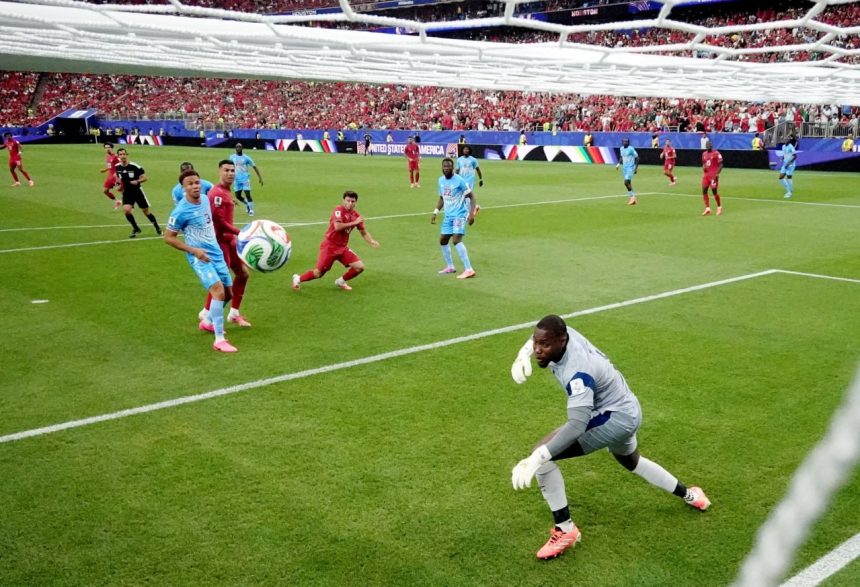
The tactical persistence was rewarded in the 45+5th minute. From a corner sequence, Arthur Masuaku delivered a wicked, swinging cross into the heart of Portugal’s penalty area. The tracking defensive line failed to organise their individual assignments and the unmarked Yoane Wissa ghosted in at the back post, powering a header home past Diogo Costa to send the stadium into raptures and level the match at 1-1 at half-time.
The equaliser was entirely deserved based on the quality and volume of DR Congo’s chances across the first 45 minutes. DR Congo had outperformed their possession share so comprehensively that the 1-1 scoreline actually understated how effectively Desabre’s system had neutralised one of the most star-studded attacking midfields in world football.
Second Half: Martínez’s Adjustments & Near-Misses at Both Ends
Sensing the complete lack of attacking width, Martínez made a half-time substitution withdrawing Bernardo Silva for the explosive Francisco Conceição, later introducing Rafael Leão to inject pure pace. While the changes offered temporary improvement in Portugal’s wide presence, the fundamental structural problem remained: the entire team continued to function as a delivery service for Ronaldo rather than constructing fluid, varied team goals.
The final ten minutes descended into a chaotic, transitional affair. Desabre introduced fresh legs in Charles Pickel and Simon Banza, and the Leopards nearly snatched a historic victory. In the 78th minute, Bakambu burst through the centre and slid a pass to Noah Sadiki, who fired just wide of Diogo Costa’s near post coming agonisingly close to a result that would have been one of the 2026 World Cup’s great upsets.
Portugal responded by throwing numbers forward, with Fernandes unleashing a fierce 25-yard strike in the 91st minute that dragged just wide. The final whistle confirmed a result that the statistics had long suggested was the fairest outcome of a genuinely competitive match.
Group K Implications: What Portugal Must Fix Before the Uzbekistan Match
The 1-1 draw leaves Portugal in a precarious position in Group K level on one point with DR Congo heading into the second round of fixtures. With Colombia and Uzbekistan completing the group, the path to the knockout stages remains very much open, but the tactical issues exposed against DR Congo demand urgent resolution before they face a more direct challenge to their World Cup ambitions.
Martínez’s tactical wake-up call is clear. A midfield of Vitinha, Neves, Silva, and Fernandes possesses enough world-class talent to dismantle any defensive system on earth but only if they coordinate their movements and work as a unit rather than as isolated individuals serving a single focal point. The specific adjustments required are:
- Establish clear positional structure — preventing Fernandes from dropping into Vitinha’s zone and Silva from congesting the central channels
- Restore variance to the final third — abandoning the compulsive bias toward Ronaldo and trusting the natural instincts of the creative players around him
- Exploit wide channels systematically — using Leão and Conceição’s pace to stretch defensive lines before playing inside rather than crossing into a congested box
If Portugal can restore structural balance and attacking variety, their title ambitions remain entirely intact. If they remain tactically stubborn, organised lower blocks will continue to frustrate them throughout the tournament.
Frequently Asked Questions: Portugal vs DR Congo 2026 World Cup
What was the result of Portugal vs DR Congo at the 2026 World Cup?
Portugal and DR Congo drew 1-1 in their Group K opener at NRG Stadium, Houston on June 17, 2026. João Neves scored for Portugal in the 6th minute before Yoane Wissa equalised for DR Congo in first-half stoppage time (45+5′).
How did DR Congo score against Portugal?
Yoane Wissa scored DR Congo’s equaliser in the 45+5th minute ghosting in unmarked at the back post to power a header home from Arthur Masuaku’s swinging corner delivery. The goal came despite Portugal controlling 80% of the first-half possession and sent DR Congo into the half-time break level at 1-1.
Why did Ronaldo struggle against DR Congo?
Ronaldo was effectively neutralised by DR Congo’s three-man central defensive unit of Chancel Mbemba, Axel Tuanzebe, and Steve Kapuadi, who physically outnumbered and crowded him every time he received the ball. Compounding the problem was Portugal’s own tactical dysfunction teammates repeatedly forced the ball into Ronaldo in crowded areas rather than constructing open team chances through natural passing patterns.
Who scored for Portugal against DR Congo?
João Neves scored Portugal’s goal heading home a Pedro Neto cross in the 6th minute for his first World Cup goal at just 21 years of age. The goal made him one of Portugal’s youngest World Cup scorers at a major tournament.
What group are Portugal and DR Congo in at the 2026 World Cup?
Portugal and DR Congo are in Group K of the 2026 World Cup, alongside Colombia and Uzbekistan. After their 1-1 draw, both teams have one point. Portugal’s next fixture is against Uzbekistan, while DR Congo face Colombia. Full Group K standings are available at the FIFA official website.
What does the draw mean for Portugal’s World Cup chances?
The draw is a significant setback but not a fatal one. Portugal still have fixtures against Uzbekistan and Colombia in Group K both winnable games. However, the tactical issues exposed against DR Congo particularly the sterile possession, Ronaldo-centric attacking patterns, and midfield coordination failures must be urgently resolved if Portugal are to justify their status as tournament contenders.