Boston Stadium was supposed to host a golden boot showdown between Kylian Mbappé and Erling Haaland — the 2026 World Cup’s two most feared strikers going head to head in a Group I finale that had been marketed as one of the tournament’s glamour fixtures. Instead, France tore up the script entirely and handed the stage to someone else. Ousmane Dembélé — 2025/26 Ballon d’Or winner — delivered a performance of breathtaking, record-breaking quality that catapulted France into the knockout rounds as the tournament’s most frightening attacking force.
A 25-minute first-half hat-trick. A defiant penalty save from Mike Maignan. A stoppage-time header from Désiré Doué. And Haaland watching the entire 90 minutes from the substitute bench. France won 4-1, completed a perfect group stage campaign with nine points and ten goals, and left every remaining World Cup contender with the same uncomfortable question: how do you stop this team? For football fans across Kenya and the entire African continent watching the 2026 World Cup unfold, this was the France performance that confirmed what the draw had always suggested — Les Bleus are the team to beat.
📊 France vs Norway — 2026 World Cup Match Stats
- Final Score: Norway 1-4 France
- Venue: Gillette Stadium, Boston, USA — June 26, 2026
- Goals: Dembélé (6′, 19′, 31′), Aasgaard (20′), Doué (90+4′)
- Dembélé’s hat-trick: Completed in just 25 minutes — only 2nd first-half WC hat-trick in history
- Golden Boot impact: Dembélé joins Mbappé & Haaland on 4 goals (race blown wide open)
- Penalty miss: Strand Larsen (49′) saved by Maignan
- France possession: 58%
- Norway changes: Rotated heavily — Haaland & Odegaard both unused substitutes
- France group stage record: 9 pts, +8 GD, 10 goals scored
Midnight Magic in Boston: France Announce Themselves as the 2026 World Cup’s Team to Beat
The framing of this match as a golden boot showdown between Mbappé and Haaland was understandable — both players had scored four goals in two games heading into the fixture, and the possibility of the world’s two most prolific strikers going head to head in a group finale carried undeniable commercial and sporting appeal. What nobody had accounted for was that France’s own most dangerous wide attacker would make both names irrelevant before half-time.
From the very first minute, France imposed an authoritative tempo that Norway’s rotated, experimental lineup had neither the quality nor the organisation to handle. The wide channels were targeted relentlessly — with Jules Koundé and Theo Hernández driving forward from full-back positions with the confidence of players operating in a system they understand intimately. Norway, missing their first-choice defensive structure along with Haaland and Odegaard, had no answers to the pace and precision of the French press.
Within six minutes, the breakthrough arrived. Within twenty-five minutes of play, the match was over. When Dembélé walked off to a thunderous standing ovation in the 64th minute, the narrative of the entire 2026 World Cup had shifted. This is France’s tournament to lose — and right now, nobody can see how any remaining opponent takes it from them.
Dembélé’s Opener: Koundé Unlocks the Right Flank in the 6th Minute
The first goal was a masterclass in how France’s system creates scoring opportunities through precise build-up play. With Norway still settling into the match and attempting to establish their defensive shape, Jules Koundé received the ball in midfield and immediately identified the space opening behind Norway’s defensive line on the right flank. His precision pass unlocked the channel perfectly — the kind of progressive delivery that requires extraordinary spatial awareness under the pressing demands of a World Cup fixture.
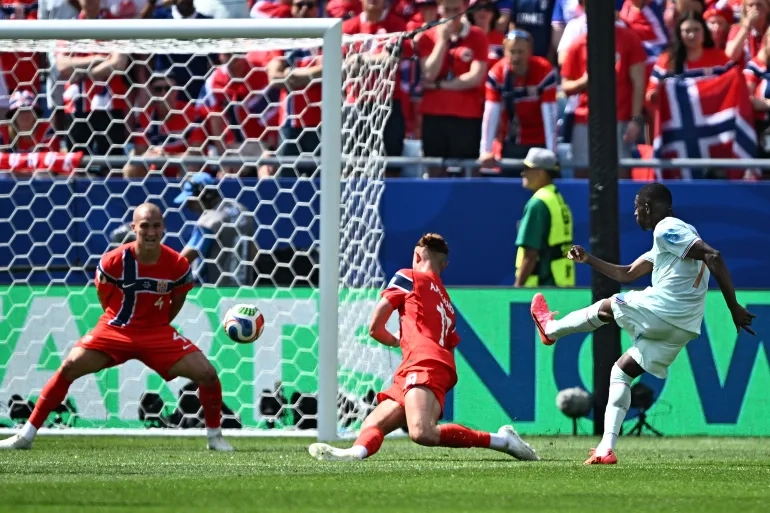
Dembélé collected the ball in full stride, immediately eliminating the recovery pace of the covering Norway defender with his initial acceleration. Rather than taking multiple touches to set himself, the Ballon d’Or winner drove directly toward the penalty area, skipping past his marker with the directness that makes him virtually impossible to stop one-on-one. The curling, low driven effort found the inside of Egil Selvik’s near post with the kind of technical precision that defends from practice. France 1-0 — and the Boston crowd exploded.
The Blitzkrieg Continues: Dembélé’s Clinical Second From Hernández’s Cross (19′)
Norway’s response to conceding early was to attempt to disrupt France’s rhythm through tactical fouls — a strategy that earned Patrick Berg a yellow card in the 9th minute for a cynical challenge designed to prevent a dangerous transition. The approach slowed the game briefly but did nothing to alter the fundamental imbalance between the two sides’ quality in the opening phase.
France’s second goal, thirteen minutes later, arrived from the opposite flank and demonstrated the two-sided threat that makes Les Bleus so difficult to defend against. Manu Koné won the ball back immediately through France’s counter-press, triggering the transition that Deschamps’ system demands within seconds of losing possession. Theo Hernández surged down the left corridor at pace, driving beyond Norway’s retreating defensive line before delivering a cross that skimmed across the face of the six-yard box at low height — the most difficult delivery for a goalkeeper to deal with and the easiest for an arriving forward to finish.
Dembélé read the trajectory perfectly, timing his blind-side run with the instinct of a player who has practised this exact movement thousands of times. He side-footed a clinical first-time finish into the roof of the net — 2-0 — without breaking stride. Norway were being overwhelmed by a team operating at a level they simply could not match with their rotated lineup.
Norway’s Brief Lifeline: Aasgaard’s Clever 20th-Minute Finish
Credit must be given where it is briefly, however inadequately, due. Just 79 seconds after France’s second goal, Thelo Aasgaard — the young Norwegian midfield asset who carries a French mother’s heritage — produced the individual moment of quality that gave the Scandinavian supporters something to cheer about in a match that had rapidly become one-sided.
Catching France’s defensive line momentarily disorganised in the immediate aftermath of their own goal celebration, Aasgaard received the ball at the edge of the penalty area from a quick restart and — rather than hesitating or looking for a teammate — immediately struck a tidy, well-directed finish past Maignan to pull the score back to 2-1. For approximately eleven minutes, the remote possibility of a dramatic Norwegian recovery scenario flickered.
Then Dembélé ended it permanently in the 31st minute.
The Hat-Trick: Dembélé’s 31st-Minute Diagonal Seals a Historic World Cup Performance
The third goal — and the moment that completed one of the most historically significant individual performances of the 2026 World Cup — was arguably the most technically accomplished of the three. With Aasgaard’s goal having given Norway brief encouragement and the crowd noise shifting, France needed the decisive moment that would permanently end the contest. Michael Olise provided it with an extraordinary piece of creative midfield play.
Receiving the ball in a congested interior zone, Olise danced through two challenges with the effortless, directional changes that make him one of Europe’s most exciting attacking midfielders. His angled pass carved open Norway’s defensive structure with a diagonal line that created the exact corridor Dembélé needed to arrive in behind the backline without being caught offside. The Ballon d’Or winner read the ball’s trajectory instantly — collecting with composure and sweeping a magnificent diagonal strike into the far corner that Selvik could not reach.
Three goals in twenty-five minutes. A hat-trick. A Ballon d’Or winner living up to every expectation on the grandest stage available. The Boston crowd — filled with French supporters who had made the Atlantic crossing for exactly this kind of moment — created a wall of noise that reduced the stadium to pure sound. Dembélé stood in the centre of the pitch with arms outstretched, knowing he had just written his name into World Cup history as only the second player ever to score a first-half hat-trick in the tournament’s 96-year history.
The hat-trick also blew the 2026 Golden Boot race completely wide open. Dembélé’s four tournament goals drew him level with Mbappé and Haaland at the top of the scoring charts — making France the only nation in the competition with two players in the top three of the tournament scoring list.
Is Dembélé’s hat-trick the fastest in 2026 World Cup history?
Yes — Dembélé’s hat-trick, completed in the 6th, 19th, and 31st minutes, is the fastest individual scoring performance of the 2026 World Cup group stage. Historically, it is only the second first-half hat-trick in men’s World Cup history, after Oleg Salenko’s treble for Russia against Cameroon at USA 1994 — the last time the World Cup was held in the United States before the 2026 edition.
The Haaland Conundrum: Why Norway’s Elite Long-Game Strategy Makes Perfect Sense
As the second half began, the discourse among analysts focused almost entirely on one subject: the man not on the pitch. Erling Haaland — joint top scorer in the tournament with four goals from back-to-back braces against Iraq and Senegal — sat anchored to the substitute bench for the full ninety minutes, watching a match that had been marketed around his potential head-to-head with Mbappé from a distance.
Manager Ståle Solbakken’s decision is more strategically coherent than the television cameras suggested in the moment. The calculation was precise:
- Norway’s qualification was already confirmed — they had nothing meaningful to gain from group stage positioning that could not be recovered in the knockout rounds
- A physical clash with France’s relentless pressing system carries genuine injury risk for their most irreplaceable asset — a risk with zero reward given the guaranteed second-place finish
- Haaland will enter the Round of 32 against Ivory Coast at full physical capacity — having avoided the accumulated fatigue that a high-intensity France match would have generated in his legs and muscles
- The psychological reset of watching from the bench, rather than being contained by Upamecano and Lacroix, means Haaland arrives at the knockout stages without the confidence dip that a potentially difficult individual performance against elite centre-backs might have created
Norway’s coaching staff are playing a long game — and it is a game that a team built around a single world-class goal scorer must play. The 4-1 defeat to France’s second-string opposition matters not at all if Haaland destroys Ivory Coast in Dallas on Tuesday.
Second Half: Penalty Miss, Deep Rotations & Doué’s Stoppage-Time Sealer
Both managers used the second half as a squad management exercise. Solbakken immediately introduced Morten Thorsby and Marcus Holmgren Pedersen to shore up the central defensive structures that had been so comprehensively exploited in the first half. Deschamps — satisfied with the three-goal cushion and the Hat-trick secured — withdrew Dembélé to a thunderous standing ovation in the 64th minute, handing valuable tournament minutes to Bradley Barcola and Rayan Cherki.
Norway were handed the opportunity to restore some pride in the 49th minute when the referee pointed to the spot following a heavy challenge in the penalty area. Jørgen Strand Larsen stepped up — but the delivery lacked both pace and direction. Mike Maignan read the shot perfectly, diving to his right and turning away the weak spot-kick with an elegant reflex stop. The penalty miss shattered Norway’s remaining momentum and converted the final thirty minutes into a comfortable French possession exercise.
The finishing flourish arrived deep into stoppage time — and it came from an unlikely source. In the 94th minute, Bradley Barcola manufactured space along the left byline, checking back onto his right foot before delivering a pin-point swinging cross toward the far post. Rising above his marker with textbook timing, Désiré Doué guided a powerful header over Selvik’s outstretched arm into the top corner — his first goal of the 2026 tournament and the perfect final exclamation mark on a night of French brilliance. 4-1. Perfect group stage record confirmed. The statement had been delivered.
Final Group I Standings & Round of 32 Fixtures
📊 Final Group I Standings
| Pos | Team | P | W | D | L | GD | Pts |
|---|---|---|---|---|---|---|---|
| 1 | 🇫🇷 France | 3 | 3 | 0 | 0 | +8 | 9 |
| 2 | 🇳🇴 Norway | 3 | 2 | 0 | 1 | +1 | 6 |
| 3 | 🇸🇳 Senegal | 3 | 1 | 0 | 2 | +2 | 3 |
| 4 | 🇮🇶 Iraq | 3 | 0 | 0 | 3 | -11 | 0 |
📅 Round of 32 — Group I Fixtures (EAT)
- France vs Sweden (most likely) — Tuesday June 30, 1am EAT — MetLife Stadium, New Jersey
- Norway vs Ivory Coast — Tuesday June 30, 9pm EAT — AT&T Stadium, Dallas
France enter the knockout stages as the tournament’s most complete side — ten goals, eight conceded none. Norway, despite their 4-1 defeat, retain dangerous knockout potential. With Haaland fully rested and fired up against Ivory Coast’s defence in Dallas on Tuesday, the Viking Storm has every reason to believe their World Cup adventure has only just begun. The result on Friday evening does not define Norway’s tournament — the next ninety minutes does.
Frequently Asked Questions: France vs Norway 2026 World Cup
What was the score of France vs Norway at the 2026 World Cup?
France defeated Norway 4-1 at Gillette Stadium in Boston on June 26, 2026. Ousmane Dembélé scored a first-half hat-trick in the 6th, 19th, and 31st minutes. Thelo Aasgaard pulled one back in the 20th minute before Désiré Doué added France’s fourth in the 94th minute.
Who scored the hat-trick for France against Norway?
Ousmane Dembélé, the 2025/26 Ballon d’Or winner, scored all three goals for France in the first half — completing his hat-trick in just 25 minutes. His goals came via a curling drive (6′), a first-time side-foot finish from a Theo Hernández cross (19′), and a diagonal strike from a Michael Olise assist (31′). It is only the second first-half hat-trick in men’s World Cup history.
Why was Haaland not playing against France?
Norway manager Ståle Solbakken rested Haaland as an unused substitute with Norway’s knockout qualification already confirmed. The strategic decision preserved Haaland’s physical freshness for the Round of 32 against Ivory Coast, avoiding injury risk in a high-intensity France match that offered no additional reward given Norway’s guaranteed second-place group finish.
What is Dembélé’s Golden Boot tally after France vs Norway?
Dembélé’s hat-trick against Norway brought his 2026 World Cup goals tally to four goals — drawing him level with Kylian Mbappé and Erling Haaland at the top of the Golden Boot standings. France became the only nation with two players joint-top of the tournament scoring charts.
Who does France play in the Round of 32?
As Group I winners, France face the best third-placed qualifying team — most likely Sweden — on Tuesday June 30 at 1am EAT at MetLife Stadium in New Jersey. Norway face Ivory Coast in Dallas on the same day at 9pm EAT. Visit the FIFA official website for confirmed fixtures and broadcast details. Kenyan fans can watch live on DStv SuperSport.
How many goals has France scored at the 2026 World Cup group stage?
France scored 10 goals in three group stage matches — Senegal 3-1, Iraq 3-0, and Norway 4-1 — while conceding only two. Their +8 goal difference and perfect nine-point record make them the standout group stage performer of the entire 48-team tournament field heading into the knockout rounds.