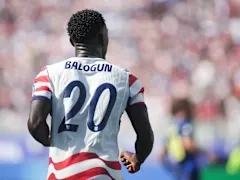
The 2026 FIFA World Cup has been engulfed in its biggest off-pitch controversy one that goes to the heart of how football’s governing body governs itself, who holds power over the sport’s most basic disciplinary rules, and whether the game’s laws apply equally to every player in every nation. At the centre of the storm is USA striker Folarin Balogun, whose automatic one-match ban following a red card in the Round of 32 has been suspended by FIFA after reported lobbying from the White House allowing him to play against Belgium in the Round of 16.
The reaction from football’s institutions has been swift and severe. UEFA has declared that FIFA “crossed a red line” and put the integrity of the game at stake. The Belgian FA has challenged the decision and is exploring legal options. Thomas Tuchel openly questioned where the new precedent ends. And former FIFA President Sepp Blatter has demanded to know where football goes if red cards can be overturned by presidential phone calls. For football fans across Kenya and the world watching this World Cup, this is the story that casts a shadow over everything else happening on the pitch.
📋 The Balogun Controversy — Key Facts
- Player: Folarin Balogun (USA) 3 World Cup goals in 2026
- Red card: vs Bosnia-Herzegovina (Round of 32) studs on Tarik Muharemovic
- Automatic consequence: One-match ban would have missed Belgium (Round of 16)
- White House intervention: Call made to FIFA President Gianni Infantino requesting review
- FIFA’s decision: One-match ban suspended for one-year probationary period Balogun available vs Belgium
- FIFA rule cited: Article 27 allows FIFA to “fully or partially suspend the implementation of a disciplinary measure”
- UEFA response: “Crossed a red line” integrity of the game at stake
- Precedent: Same rule used for Cristiano Ronaldo before the 2026 World Cup began
What Happened: Balogun’s Red Card, the Automatic Ban & FIFA’s Extraordinary Reversal
The sequence of events that produced football’s biggest governance controversy of 2026 began in the Round of 32 at Levi’s Stadium in Santa Clara, where the United States faced Bosnia-Herzegovina. Balogun who had already scored three goals at the tournament and established himself as one of the competition’s most dangerous forwards opened the scoring with his fourth World Cup goal. In the same match, he received a straight red card after catching Tarik Muharemovic with his studs in a challenge that referee Raphael Claus deemed dangerous play.
Under the automatic disciplinary provisions of the FIFA Disciplinary Code, a red card carries a minimum one-match suspension a rule that applies universally across the tournament, regardless of nationality, status, or the significance of the match being missed. Multiple players across the 2026 World Cup had already served this automatic suspension without question or complaint. For Balogun, the consequence was clear: he would miss the Round of 16 against Belgium.
Then the politics arrived. A person familiar with the matter, speaking anonymously, confirmed to the Associated Press that the White House contacted FIFA President Gianni Infantino to request a review of the red card decision. Shortly afterwards, FIFA issued a statement announcing it was invoking Article 27 of its regulations which allows the governing body to fully or partially suspend the implementation of a disciplinary measure to place Balogun’s one-match ban under a one-year probationary suspension. Balogun would be available against Belgium.
The decision was unprecedented in its combination of political context and sporting consequence. The ban was not overturned FIFA confirmed the red card stands. But the automatic suspension that is the immediate consequence of any red card was suspended entirely, on probation, for a period that conveniently covers the remainder of the tournament.
Was Balogun’s red card against Bosnia a fair decision?
Former referee Dermot Gallagher was clear in his assessment: the red card was correct under the Laws of the Game. While he emphasised that Balogun did not intend to injure his opponent, the relevant standard is consequence rather than intent. Catching an opponent on the Achilles tendon with studs constitutes dangerous play regardless of deliberateness. Gallagher added that in the Premier League, the incident would have produced not just a one-match ban but a three-match suspension making FIFA’s decision to suspend the ban entirely even more extraordinary.
Trump’s White House Call: How Political Pressure Entered World Cup Football
President Donald Trump addressed the situation personally and publicly on Monday confirming his administration’s involvement while disputing the premise that it constituted inappropriate interference. His comments combined a characterisation of the original incident as accidental with a pointed criticism of the referee who issued the card.
On the red card itself, Trump said: “That wasn’t a foul… that was two guys running full speed that happened to crash into each other. You can’t take your foot and properly place it on somebody else’s foot. These were two great athletes that got tangled up.”
More significantly and more controversially the President then offered a comment on referee Raphael Claus: “This referee is a little bit suspect. If you check his past, I don’t want to say that because I don’t like to create controversy, but very suspect.” No specific evidence or examples were provided to support this characterisation of a professional official.
After FIFA’s announcement, Trump posted on social media: “Thank you to FIFA for doing what was right, and reversing a great injustice.” The White House’s official social media account reposted his message, adding: “USA-USA-USA.”
The involvement of a sitting head of state in a World Cup disciplinary decision is without precedent in the modern era of the sport. Whatever the legal or regulatory standing of FIFA’s subsequent decision, the appearance of a direct line between a presidential phone call and a player’s availability for a knockout match has created a reputational crisis for the tournament’s governance that will be discussed long after the final whistle of the 2026 World Cup.
UEFA’s Damning Response: “FIFA Has Crossed a Red Line”
European football’s governing body issued one of the most strongly worded institutional statements in the history of the sport’s relationship between its two main governing bodies. UEFA’s response pulled no punches criticising FIFA’s decision on grounds of principle, consistency, and the fundamental integrity of competitive sport.
The UEFA statement read: “Yesterday’s decision to suspend for a probationary period of a year the implementation of the one-match automatic suspension following the red card issued to the player Folarin Balogun crossed a red line. Football, like any other sports, relies on rules, which are the basis for fair, honest and transparent competition. Sometimes rules are open to interpretation. In this case not.”
UEFA identified two specific concerns that elevate this beyond a single disciplinary dispute. First, the question of consistency: “A minimum automatic suspension of one match following a red card is not a discretionary option… Several other players have been in the same situation and regularly served their suspension.” If the rule is applied to all other players but waived for Balogun, the tournament’s disciplinary framework loses the universal application that gives it legitimacy.
Second, the question of precedent: “Such decision creates a precedent in the ongoing tournament, where similar situations will now require an equal treatment, to the detriment of the competition.” In practical terms, this means that every future red card at the 2026 World Cup could theoretically be subject to the same Article 27 review a scenario that would make tournament discipline entirely unpredictable.
The statement concluded with language that describes the situation in the most serious possible terms for football’s governance: “We express our disbelief at such an unprecedented, incomprehensible and unjustifiable decision.”
Belgium’s Legal Challenge: The FA That Won’t Accept FIFA’s Decision
Belgium, as the team directly disadvantaged by FIFA’s decision, have responded with the only available mechanism remaining to them: a formal challenge to the decision’s legitimacy. The Belgian FA’s response has been remarkable for both its content and the procedural criticism it contains about how FIFA handled the entire process.
In an initial statement, the Belgian FA said it was “astonished” by FIFA’s decision. In a subsequent, more detailed statement, the organisation revealed the specific manner in which FIFA appeared to have made the appeal process extraordinarily difficult or deliberately impossible to navigate effectively.
The Belgian FA stated that it had still not received either FIFA’s decision or any explanation of the process when it contacted the governing body. When it sent a letter requesting these documents, FIFA responded not by providing the information requested but by informing the RBFA that their letter of enquiry itself constituted a formal appeal, that a judge had been appointed, and that the Belgian FA had only a few hours to complete the full appeal process.
The implication of this sequence that FIFA structured the notification and response timeline in a way that made meaningful appeal almost impossible is the most damaging procedural allegation in the entire controversy. The Belgian FA confirmed it would challenge Balogun’s eligibility for the match, though it stopped short of specifying the jurisdiction in which any further appeal would be pursued.
Can Belgium stop Balogun from playing against USA?
The Belgian FA is challenging FIFA’s decision and investigating all potential options, but the timeline makes any successful intervention before the match extremely difficult. FIFA’s procedural management of the appeal process informing Belgium that their information request constituted an appeal with only hours to respond has made meaningful challenge practically challenging. Balogun is expected to be available for the Round of 16 fixture as FIFA’s decision currently stands.
Tuchel’s Response: England’s Manager Asks the Question Nobody Can Answer
The controversy arrived at the worst possible moment for Thomas Tuchel whose own player, Jarell Quansah, received a red card against Mexico and is now set to serve the exact automatic one-match suspension that FIFA has waived for Balogun. The juxtaposition was impossible to ignore, and Tuchel addressed it with a directness that cut through the diplomatic language surrounding the broader debate.
In his post-match press conference after the Mexico victory, Tuchel said: “Where to draw the line? That’s the question I ask and I have no answer to that where does it end? Do we appeal if a yellow card is not a yellow card? Do we not think it’s not a red card where does it start and where does it end?”
When asked, with evident irony, whether Harry Kane might ask President Trump to intervene on Quansah’s behalf, Tuchel replied: “Maybe. That’s a good start.”
England’s official position echoed by Downing Street was that disciplinary decisions are a matter for FIFA and should remain so. The Prime Minister’s spokesman confirmed the UK government’s view that such decisions “are a matter for the football world governing body and should stay that way.” On whether FIFA’s integrity had been compromised, the spokesman pointedly deflected: “It’s a matter for FIFA to respond to.”
The Ronaldo Precedent: FIFA Has Used Article 27 Before at This Same World Cup
Perhaps the most significant context in this entire controversy is one that has received considerably less attention than the political dimensions: this is not the first time FIFA has used Article 27 to suspend a disciplinary measure at the 2026 World Cup. It did it for Cristiano Ronaldo too.
Ronaldo faced a three-match ban for an elbow on Republic of Ireland’s Dara O’Shea during a World Cup qualifier a suspension that would have ruled him out of Portugal’s first two group games at this tournament. FIFA invoked the same Article 27 provision to suspend the final two games of Ronaldo’s ban, allowing him to play from the start of the World Cup.
The precedent is genuinely significant both as context for understanding FIFA’s willingness to apply Article 27 broadly, and as an illustration of why UEFA’s charge of consistency failure has such force. If Article 27 can be applied to Ronaldo pre-tournament and Balogun during it, the question of which red cards and which players qualify for this exceptional treatment and on what basis becomes impossible to answer with any consistency or transparency.
Blatter’s Warning: The Question That Haunts World Football’s Governance
The most unexpected voice in the controversy has been that of former FIFA President Sepp Blatter, who took to social media to deliver a warning about where FIFA’s decision leads. Blatter’s critique, whatever the complicated context of his own FIFA tenure, carries the weight of someone who understands the internal dynamics of the governing body from the inside.
His post read: “Red cards are not overturned by political phone calls. They are overturned by rules, evidence and independent bodies. If a US President intervenes with the FIFA President and a player is suddenly cleared before a World Cup knockout match the question is unavoidable: Quo vadis (where are you going), FIFA? Football must never become a playground for political power.”
The phrase Quo vadis Latin for “where are you going” is the question that now hangs over this tournament and over FIFA’s credibility as a neutral governing body. If the answer to that question is “wherever the most powerful nation’s government directs us,” the foundations of international football’s governance have been shaken in ways that cannot easily be repaired.
For the millions of football supporters across Africa, Asia, South America, and everywhere else in the world who have no presidential hotline to FIFA’s offices, the principle at stake is simple: the rules must apply to everyone equally, or they apply to no one meaningfully. That principle, as UEFA has made clear, is now in serious question.
Frequently Asked Questions: Balogun FIFA Ban World Cup 2026
Why was Balogun’s World Cup ban overturned?
Balogun’s one-match ban was not technically overturned its implementation was suspended for a one-year probationary period by FIFA under Article 27 of its regulations, which allows the governing body to fully or partially suspend the implementation of a disciplinary measure. The red card itself still stands. The White House is reported to have contacted FIFA President Gianni Infantino to request a review of the decision.
What did Trump say about Balogun’s red card?
US President Donald Trump described the original challenge as two athletes running full speed and getting tangled dismissing it as accidental rather than dangerous. He also called the referee “a little bit suspect” without providing specific evidence. After FIFA’s decision, he posted on social media: “Thank you to FIFA for doing what was right, and reversing a great injustice.” The White House’s official account added: “USA-USA-USA.”
What did UEFA say about the Balogun ban reversal?
UEFA released a strongly worded statement declaring that FIFA had “crossed a red line” and put the “integrity of the game at stake.” UEFA argued that a one-match automatic suspension following a red card is not a discretionary option, that other players in the same situation had served their suspensions, and that the decision set a dangerous precedent for the rest of the tournament. The statement concluded by expressing “disbelief at such an unprecedented, incomprehensible and unjustifiable decision.”
Is Belgium challenging Balogun’s eligibility?
Yes the Belgian FA is challenging FIFA’s decision and investigating all potential legal options. The RBFA also criticised FIFA for making the appeal process practically impossible informing Belgium that their information request constituted a formal appeal with only hours remaining to respond. Belgium confirmed they have still not received FIFA’s decision or any explanation of the process through official channels.
Has FIFA used Article 27 before to suspend bans?
Yes FIFA used the same Article 27 provision for Cristiano Ronaldo before the 2026 World Cup began, suspending two games of Ronaldo’s three-match ban for an elbow on Dara O’Shea of the Republic of Ireland during a World Cup qualifier. This allowed Ronaldo to play from Portugal’s first group game. The precedent makes UEFA’s consistency argument even more powerful and raises questions about which players qualify for this exceptional treatment.
What does this mean for future red cards at the 2026 World Cup?
As UEFA explicitly warned, FIFA’s decision creates a precedent in the ongoing tournament where similar situations may now require equal treatment. In practical terms, any future red card recipient or their nation’s government could theoretically invoke the same Article 27 review that allowed Balogun to play. Whether FIFA applies the provision consistently, or whether it is only available to certain nations with sufficient political influence, will define its credibility for the remainder of the tournament. Visit the FIFA official website for official statements on the disciplinary situation.