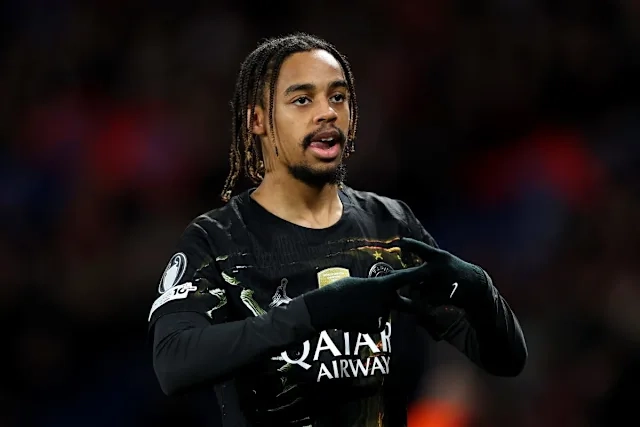
Bradley Barcola could be the most expensive transfer of the entire 2026 summer window and the clubs chasing him are two of England’s most ambitious. Liverpool and Arsenal are both firmly in the picture for the 23-year-old Paris Saint-Germain and France international, whose combination of pace, physicality, tactical intelligence and Champions League pedigree has made him one of the most coveted wide forwards in world football.
But who exactly is Bradley Barcola? How did he get here? What does he do brilliantly, where does he still need to improve and which club is the better fit? Having spoken to the man who coached him as a boy at Lyon’s academy, here is the complete picture.
The Rise: A Story of Patience, Timing and a Lucky Break
For a player now attracting fees that could break transfer records, Barcola’s route to the top was anything but straightforward. His former Lyon academy coach Jean-François Vulliez who followed Barcola to PSG and now works as a development coach for the French champions tells a story defined not by prodigy-level early brilliance but by patience, late physical development and a fortunate turn of events that changed everything.
At Lyon, Barcola was on the fringes of the first team under Laurent Blanc talented enough to stay but not yet established enough to be considered essential. A Swiss club had expressed interest in taking him on loan precisely because his pathway to minutes looked blocked. Then, unexpectedly, the situation changed.
“Karl Toko Ekambi decided he wanted to leave,” Vulliez explained, “so the coach decided to stop the loan because we might need Bradley. It was a key moment because he realised that if Toko Ekambi left, Bradley could be a solution and there was an opportunity to use him. Toko Ekambi did leave. Bradley stayed. One match later, there was an injury and Laurent needed him.”
What followed was the kind of form that transforms careers. Barcola scored five goals in nine games in early 2023 and after impressing for France at that summer’s European Under-21 Championship, a protracted move to PSG followed. His body was in Lyon. His head was already in Paris.
The three seasons since have delivered 13 trophies and 39 goals in over 150 appearances for the French and European champions making him one of the most decorated 23-year-olds in world football.
What His Academy Coach Reveals About His Development
Vulliez’s assessment of Barcola is valuable precisely because it extends across the full arc of his development from unheralded academy player to Champions League winner and it contains details that are not visible in the statistics.
“He was a normal kid,” Vulliez said. “He never played above his age category, never jumped a stage. His maturation was a normal process. He never played for France’s age-group teams. He was a good player but not physically ready.”
The contrast with other elite talents is deliberate and instructive. “Sometimes there are players like Mbappé who mature very early. Others need time. We were very patient with him at Lyon because we knew he had the skills, we just had to wait for that maturation process that psychological maturation, that physical maturation. When that transformation eventually happens, they will improve quickly.”
The key insight from that patience is one that defines who Barcola is today. Because he could not dominate opponents physically as a teenager, he was forced to find other ways to be effective. He learned to read the game. He learned to use space. He learned the timing of runs. He developed his intelligence before he developed his muscles and when the physical transformation eventually arrived, it combined with that intelligence to produce something genuinely special.
“He was able to scan the pitch, take good information and use the space,” Vulliez explained. “Very early, he had this and he had speed. Then, he progressed with his muscles, became powerful. It is a combination of these tactical abilities, technical abilities and physical abilities.”
What Barcola Does and Why Top Clubs Want Him
Understanding Barcola’s profile requires knowing that he is not a conventional winger. He played as a centre-forward at Lyon until the age of 17 and those instincts have never left him.
Operating primarily from the left flank at PSG, Barcola’s natural tendency is to cut inside and shoot into the far corner with his stronger foot the movement pattern of a striker who happens to start wide rather than a winger trying to play like one. Those instincts are extremely difficult to coach into a player. Top clubs covet them because they turn wide players into goal threats and Barcola’s shot volume ranks among the top 10 in Ligue 1 per 90 minutes, a remarkable figure for a player deployed on the wing.
His pace is elite he ranked among the top 10 fastest players in the Champions League last season. But it is the intelligence attached to that pace that makes him genuinely dangerous. He knows when to run at defenders and when to keep it simple. He knows when to come inside between the lines and when to continue his run beyond the defence. Under Luis Enrique at PSG, he has taken considerably better care of the ball his passing sonars showing a player who has evolved from an exciting but occasionally wasteful wide forward into a technically disciplined attacker who understands the moments that matter.
“He is very clever with his runs inside,” Vulliez noted. “The timing of those movements is an important trait. Because he played as a striker, he retains that ability to know when he needs to come inside and when he needs to run beyond.”
His passing data also reveals a player comfortable on both sides of the pitch. He has operated on the right as well as the left a positional flexibility that gives coaches tactical options and makes him harder for defenders to prepare for.
Where He Still Needs to Improve
The honest assessment of Barcola’s current level acknowledges one clear developmental area: finishing. His shot volume is impressive. His conversion rate is not yet at the level his talent suggests it should be a gap that his PSG manager Enrique has actively pushed him to close.
“His finishing can be a little lax,” Vulliez acknowledged. “Enrique has pushed him to become more clinical. But there is time. There are many very good players who improved their finishing when they became more mature.”
The trajectory of his development from a teenager who was not physically ready, to a 23-year-old who has won back-to-back Champions Leagues suggests the finishing will come. The question for the clubs pursuing him is whether they are buying the finished product or investing in the player he is still becoming. The answer appears to be both.
“I believe he is able to become a No 9,” Vulliez added. “Maybe the left wing is the better position for him right now but I am curious to see how he develops because he has the mind to do it.”
Why He Is Available: Kvaratskhelia’s Arrival Changed the Hierarchy
Despite winning back-to-back Champions Leagues with PSG, Barcola is available this summer for a reason that reflects competitive squad dynamics rather than any failure on his part. Khvicha Kvaratskhelia’s arrival from Napoli in January 2025 established the Georgian international as Luis Enrique’s first choice on the left and Barcola found himself coming off the bench in both Champions League finals as a result.
That substitutes’ role in the biggest matches of the European calendar has understandably prompted reflection from a player of Barcola’s quality and ambition. At 23, with the physical peak of his career still ahead of him, the desire for guaranteed starting minutes at the highest level is entirely understandable and the Premier League clubs pursuing him are offering exactly that proposition.
Is Liverpool the Right Fit?
The tactical case for Liverpool is compelling arguably more so than any other club in the race. Andoni Iraola’s system rewards exactly the profile Barcola brings, and the specific gap his departure would fill is clearly identifiable.
Liverpool lost the off-the-ball movement of Luis Díaz, Diogo Jota and Darwin Núñez this past season and looked a fundamentally different team as a result. Florian Wirtz now at Anfield is at his best when sliding passes through the lines for intelligent runners who time their movements to exploit the space created. Barcola, whose entire game is built on exactly that kind of intelligent running from wide positions, would be the ideal wide partner for Wirtz in Iraola’s system.
The personal qualities Vulliez describes also fit Liverpool’s culture. “We never had a problem with him at the academy because he is intelligent and listens so when you are the coach, that makes it easier to manage him because he can adapt to whatever strategy the coach wants to use. He understands because he is clever.”
A player who listens, adapts, runs intelligently and combines well in a system built around Wirtz’s line-breaking passes and Iraola’s pressing intensity represents an almost perfect fit.
Is Arsenal the Right Fit?
Arsenal’s interest intensified following the failure to sign Morgan Rogers, who ultimately joined Chelsea for a British record £117 million. The Gunners need a left-sided forward and Barcola ticks almost every box in Mikel Arteta’s recruitment profile technically disciplined, physically capable of pressing at intensity, intelligent enough to operate in tight spaces and tactically flexible enough to fill multiple roles.
The Christos Tzolis signing has not eliminated the need for a higher-profile wide option it has supplemented a position that still requires an elite-level upgrade. With Gabriel Martinelli’s future at the club uncertain following a season of just one Premier League goal, Barcola arriving as the primary left-forward option would give Arteta a genuinely elite wide forward for the first time since Leandro Trossard’s departure.
Arsenal’s Champions League football, their sustained title challenge and the prospect of working under a manager who has developed some of the Premier League’s finest attacking players make the Gunners a credible and attractive destination.
The Verdict: How Much Better Can He Get?
The question that clubs are really asking about Barcola is not what he has already done it is what he has yet to become. And on that question, Vulliez’s final assessment is the most important thing any potential buyer can hear.
“Nobody could have imagined this,” he said of Barcola’s rise. “The question now is how much better he could still become.”
A 23-year-old who has already won 13 trophies, made over 150 appearances for PSG and contributed 39 goals, still with finishing improvement to come, positional flexibility to develop and a potential future as a centre-forward the ceiling is genuinely difficult to define.
Whether he ends up at Liverpool where the tactical fit is perhaps closest or Arsenal where the immediate opportunity and title ambition are compelling Barcola is not a gamble. He is one of Europe’s most complete young wide forwards, entering his prime, available from a club that can no longer guarantee him the starting minutes his quality demands.
This could indeed be the transfer of the summer. And whoever gets him will have landed one of the best.