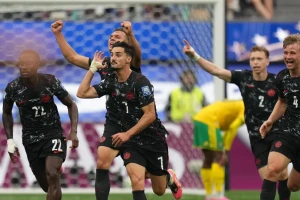

The most tactically compelling 2026 World Cup quarter-final takes place in Miami on Saturday evening and the data behind England vs Norway reveals a match of genuine nuance beneath its headline narrative. Yes, Erling Haaland is the primary threat. Yes, England’s right-back situation is a genuine tactical vulnerability. But the picture is more complex than a single striker vs a depleted defensive position and the team that understands the full tactical context will have the edge in one of the biggest matches English football has experienced in a generation.
England have a 62 per cent probability of progression according to statistical modelling but the remaining 38 per cent belongs almost entirely to one man. Here is the complete tactical breakdown of every key battle in Miami: the statistics, the individual duels, the midfield axes, and the specific decisions Thomas Tuchel must get right. For football fans across Kenya and the African continent watching this extraordinary tournament, this is the analysis that explains what is actually going to happen on the pitch.
📊 England vs Norway — Tournament Data Comparison
| Metric | 🏴 England | 🇳🇴 Norway |
|---|---|---|
| Goals scored | Less | More |
| Shots on target | More | Less |
| Total xG | Higher | Lower |
| xG per shot (quality) | Lower | Tournament’s highest |
| Goals conceded per game | Lower | 1.8 (highest of remaining 8) |
| Primary goal threat | Bellingham + Kane | Haaland (7 goals) |
England vs Norway: What the Data Tells Us About Saturday’s Quarter-Final
The statistical picture of England and Norway at this World Cup reveals a fascinating asymmetry that cuts to the heart of what makes Saturday’s quarter-final so tactically interesting. England are the better team by almost every volume metric more shots on target, more total expected goals, more big chances, far more passes into the opposition box. Norway, by contrast, rank among the lower-volume attacking sides in the tournament.
And yet Norway have scored more goals than England. The explanation for this paradox sits entirely with one man and his conversion rate is among the most extraordinary numbers produced at any World Cup in the modern era.
Norway have the tournament’s highest xG per shot meaning the chances they create tend to be of the highest possible quality. England have the quantity. Norway have the quality. And when the quality is being converted by Erling Haaland, the volume advantage becomes considerably less meaningful than it appears on paper.
Haaland’s Terrifying Tournament Ratio: One Goal Every 14 Touches
The single most alarming statistical reality in England’s pre-match preparation the number that Tuchel’s coaching staff will have examined more closely than any other is Haaland’s conversion efficiency at the 2026 World Cup. The Manchester City striker has scored seven goals from just 12 shots on target, taking only six shots off target across the entire tournament. His non-penalty expected goals figure of 4.32 is higher than any other player in the competition.
And then there is the raw efficiency metric that captures his threat most vividly: Haaland has scored once every 14 touches in this tournament. Not once every 14 shots. Once every 14 touches of the ball in any context. For a striker who does not accumulate touches in the way that creative midfielders or wide forwards do who specifically positions himself to receive in the most dangerous areas and convert in the fewest possible touches this is a ratio that should terrify any defence in the world.
The Brazil comparison is instructive and sobering. Gabriel one of the outstanding Premier League central defenders of the past two seasons kept Haaland largely quiet for 80 minutes in Norway’s Round of 16 win. Limited touches. Minimal influence. And then, in the 85th minute, Haaland climbed over Gabriel from a left-wing cross and headed home emphatically. The lesson: keeping Haaland quiet for 80 minutes is entirely possible and entirely insufficient. He needs only one moment.
Andreas Schjelderup — Norway’s wide threat has created three chances specifically for Haaland despite playing only 183 tournament minutes. England must identify and neutralise the supply line to Haaland from wide areas before it arrives because by the time the ball is in the air and Haaland is running, the damage is almost impossible to prevent.
How do you stop Erling Haaland in a World Cup quarter-final?
Ezri Konsa has already identified the primary defensive requirement: “Stop the crosses one million per cent.” Haaland’s most dangerous delivery position is from wide areas where he can attack the ball in the air his ability to time runs, generate power from standing starts, and win aerial duels against elite defenders makes cross prevention the single highest-priority defensive task. England must also ensure centre-backs Konsa and Burn (or Guehi if fit) stay tight to him inside the box and deny the half-step of space that he converts into goals.
England’s Attacking Numbers: Kane, Bellingham & Why Attacking Volume Must Convert
England’s attacking data is genuinely impressive in the context of the tournament and provides legitimate reason for confidence that the Three Lions can create enough to win this match, provided the defensive work on Haaland is adequately managed.
Harry Kane has scored six goals from 19 shots — ten of which have hit the target across five tournament appearances. His conversion rate is among the best in the competition. Two of his goals have been penalties, which means his four open-play goals reflect genuine positional quality and clinical finishing not just penalty-taking composure under pressure.
Jude Bellingham has scored four times and has narrowly edged Kane for open-play expected goals a statistic that reflects his tendency to arrive late into high-danger areas from deeper positions, a movement pattern that defences find almost impossible to track across 90 minutes because it originates from a midfield starting point rather than a striker’s run from deep.
The concentration of England’s scoring is both a strength and a vulnerability. Only Marcus Rashford has scored alongside Bellingham and Kane for Tuchel’s side meaning Norway’s defensive structure needs only to focus on two primary threats without significant fear of punishment from wide areas or from deeper midfield runners. England must find ways to create from multiple angles against a Norwegian defensive shape that will be specifically prepared for Kane and Bellingham.
England’s Line-Breakers vs Norway’s Odegaard-Berge Midfield Axis
One of the match’s most important tactical subplots sits in the middle of the pitch and it involves one of England’s strongest attributes colliding with one of Norway’s most established strengths.
England have shown impressive capability for breaking defensive lines across this tournament. Elliot Anderson has been the primary ball-carrier and line-breaker in midfield. Ezri Konsa perhaps surprisingly for a centre-back emerges as one of England’s most prolific players for threading passes through opposition midfield and attacking banks. Bellingham, Rice, and Kane all feature in the line-breaking data, underlining the variety of England’s progression routes from their own half into threatening areas.
However, Norway have been equally effective at this. Their system for building out and threading passes through pressing structures is sophisticated and it operates primarily through the partnership between Martin Odegaard and Sander Berge, who have exchanged a tournament-high 128 passes between them during the competition. This creates a clearly identifiable midfield axis and a clearly identifiable target for England’s disruption strategy.
Tuchel will want England to prevent Odegaard from receiving in positions where he can turn and drive forward, and to stop Berge from punching passes through the first lines of England’s press with the incisive forward delivery that has set Haaland free in every tournament game Norway have played. Anderson’s ball-winning capacity will be England’s primary midfield weapon he leads the squad for possession won, interceptions, and tackles, and physically disrupting Norway’s central partnership is as important as any tactical structure England deploy defensively.
The Anderson vs Odegaard high-speed running battle is also a compelling subplot in its own right. The two players are almost level in high-speed run statistics at this tournament meaning the space between the lines of both teams will be contested with a physical and technical intensity that could define which way the midfield battle goes.
England’s Defensive Vulnerability: The Right Flank That Norway Will Target
The data contains one clear signal that Norway’s coaching staff will have identified and plan to exploit. Opponents at this World Cup have attacked England’s right flank more frequently than the opposite side with 39 per cent of opposition threat directed down England’s right side compared to 35 per cent down the left. The difference is small but statistically consistent across multiple matches, suggesting that opposition teams have identified a structural weakness on that flank.
The reasons are obvious: England’s right-back position has been occupied by Quansah (now suspended for two matches), Spence (limited knockout-stage experience), and potentially James (three weeks without training due to his hamstring). None of these represents the settled, high-quality defensive option that the right flank requires against a Norway side with Schjelderup and Alexander Sorloth providing wide width and diagonal depth.
If James is not cleared to start and the decision on that will be made by Tuchel after final medical consultation Norway will press the right channel aggressively from the opening minutes. Their width patterns show they have used the left channel more than the right in this tournament which, facing England from the attacking perspective, means attacking down England’s right side. This is not a coincidence. It is a planned exploitation of the weakness they have identified.
The good news for England: Norway concede 1.8 goals per game more than any other side remaining in the tournament. Their defensive structure, while organised, is penetrable at a higher rate than any remaining opponent England could have faced. If England’s attacking quality comes to fruitionand the data suggests it should against a Norway defence that has leaked at this rate the right-back problem becomes a manageable risk rather than a fatal weakness.
Running Power & Speed: Haaland at 36.5km/h & Bellingham’s Sprint Count
The physical dimension of this quarter-final adds a further layer of complexity particularly given the Miami heat that both squads will be managing across 90-plus minutes.
Haaland has clocked the fifth-fastest speed at the 2026 tournament reaching 36.5km/h against France. For a player of his physical size and aerial orientation, this speed is almost uniquely dangerous because it means he can make the same explosive runs that every Premier League left-back has nightmares about, but applied to the specific context of World Cup knockout football where the defensive margins are even tighter.
Anthony Gordon is not far behind at 35.8km/h — which matters for England’s attacking rather than defensive game. Gordon, who has provided two consecutive knockout-stage assists from the bench, carries the kind of pace that Norway’s defenders who have been largely successful at managing opposition wide threats will need to respect differently from the group-stage opponents they faced.
The sprint data carries an important and encouraging number for Tuchel: Jude Bellingham has made more sprints at this tournament than any outfield player except Morocco’s Ismael Saibari and Belgium’s Timothy Castagne. This is not just an impressive physical statistic it explains precisely why Bellingham’s late arrivals into the box have been so consistently effective. He is running further and faster than almost any midfielder in the tournament, generating the momentum and unpredictability that makes tracking his late runs from deep positions so extraordinarily difficult for opposing defences.
Tactical Verdict: England Must Impose Themselves — Not Just Stop Haaland
The tactical conclusion from the data is clear, and it carries an important warning: England’s primary challenge in Miami is not merely stopping Haaland. It is ensuring that England’s own attacking volume their genuine statistical advantage over Norway is converted into the goals that the data suggests they are capable of creating against a Norwegian defence that has conceded more than any other remaining team.
England will look to:
- Block crosses and wide supply to Haaland — the single most important defensive task; Haaland’s most dangerous delivery position is from the wide areas that Norway’s right-side attackers aim to reach
- Disrupt the Odegaard-Berge axis — specifically preventing Odegaard from receiving in turned positions and stopping Berge from punching passes through England’s midfield press that release Haaland in transition
- Exploit Norway’s right flank — Norway have shown vulnerability in wide defensive areas when faced with direct running and pace; Gordon and O’Reilly’s runs down England’s left could be decisive
- Press high and maintain the ball — England’s xG data reflects a team that creates most when they sustain possession in and around the opposition box; Norway’s defensive weakness at 1.8 goals per game suggests England’s pressure will eventually tell
- Trust the Bellingham-Kane combination — England’s last 11 World Cup goals have come from these two players; the attacking relationship between them is the tournament’s most reliable English goal-scoring mechanism
Norway will sit deeper and rely on transition — fewer attacks, fewer shots, but Haaland’s conversion rate making every single opportunity potentially decisive. The team that executes their defensive game plan better in Miami takes a step toward the semi-final.
England are favoured. The data supports that assessment. But Haaland has scored once every 14 touches at this World Cup and the margin for defensive error against a player of that efficiency is essentially zero.
Frequently Asked Questions: England vs Norway 2026 World Cup Quarter-Final
What are England’s chances of beating Norway?
Statistical modelling gives England a 62 per cent probability of beating Norway in the 2026 World Cup quarter-final. England hold statistical advantages in shots on target, total expected goals, big chances created, and passes into the opposition box. However, Norway’s xG per shot is the highest at the tournament reflecting Haaland’s elite conversion rate meaning the 38 per cent Norway probability is concentrated in a single player.
How many goals has Haaland scored at the 2026 World Cup?
Erling Haaland has scored seven goals at the 2026 World Cup from just 12 shots on target with only six shots off target across the entire tournament. His non-penalty expected goals figure of 4.32 is the highest of any player in the competition. He has scored once every 14 touches of the ball at this tournament.
What is the key tactical battle in England vs Norway?
The most important tactical battle is England’s ability to stop wide supply into Haaland while simultaneously disrupting the Odegaard-Berge midfield axis that creates Norway’s best attacking positions. Odegaard and Berge have exchanged 128 passes at this tournament the most of any partnership remaining. Preventing Odegaard from turning in central areas and stopping Berge’s through-balls is as critical as the Haaland man-marking task itself.
Will England’s right-back problem affect the Norway match?
Yes it is England’s clearest tactical vulnerability. Data shows 39 per cent of opposition threat has come down England’s right flank across this tournament slightly higher than the left. Norway’s attacking pattern shows they use the left channel (attacking England’s right side) and will exploit any makeshift option at right-back. Reece James’ fitness decision is the single most consequential team-selection call Tuchel faces before kickoff.
How have England set up tactically at the 2026 World Cup?
England have played a high-pressing, pace-driven system built on attacking volume creating the most shots on target, total xG, and big chances of any team in their section. Their progression into dangerous areas has relied on Elliot Anderson’s line-breaking ball-carrying, Konsa’s progressive passing from deep, and the combination of Bellingham’s late box arrivals and Kane’s positional intelligence. Norway will try to disrupt this by sitting deeper and forcing England to create without the spatial freedom they prefer.
When and where is England vs Norway in the World Cup quarter-final?
England face Norway in the World Cup quarter-final at Hard Rock Stadium in Miami on Saturday July 11 kickoff at 1am EAT in the early hours of Sunday July 12. The winner advances to the semi-final at Mercedes-Benz Stadium in Atlanta on Wednesday July 15 at 11pm EAT. Visit the FIFA official website for confirmed team news and broadcast details. Kenyan fans can watch live on DStv SuperSport.