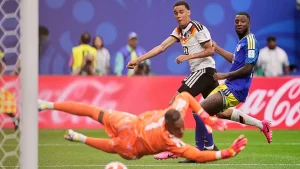
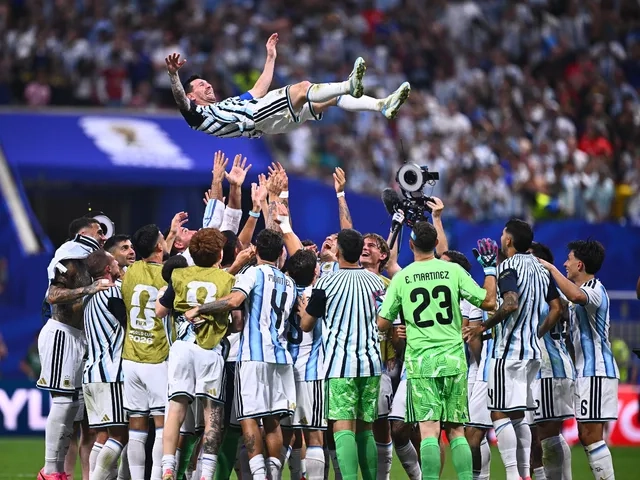
One of the most historically charged fixtures in international football is back on the biggest stage of all. England face Argentina in the 2026 World Cup semi-final in Atlanta on Wednesday a match loaded with decades of rivalry, individual superstars on both sides, and a place in the World Cup final at stake. Here is the complete tactical breakdown of how it could be won and lost.
How Close Is It? The Numbers Say a Coin Toss
According to Opta’s statistical modelling, this semi-final is about as evenly matched as a knockout game can be. England are given a 52.9 per cent probability of progression barely above the margin that separates the two sides. France are favourites on the other side of the draw, but England still carry a 22.6 per cent chance of becoming world champions if they navigate Wednesday’s challenge.
The margins are that fine. Every tactical decision Tuchel makes from the starting XI to in-game adjustments could prove decisive.
The Superstar Collision: Bellingham vs Messi
Two players will define this semi-final above all others separated by 16 years but united by the fact that their respective tournaments have been extraordinary.
Jude Bellingham has scored six goals in six appearances at this World Cup, operating in an advanced No.10 role that has made him England’s most explosive attacking force. He has scored in consecutive knockout games, his shot range is expanding with every match, and his sprint count of 328 at this tournament leaves every other player from both sides trailing by nearly 90 sprints. He is running further, pressing harder, and arriving later into dangerous areas than any midfielder in the competition. His non-penalty expected goals figure actually edges ahead of Harry Kane a remarkable statistic for a player who does not play as a centre-forward.
Lionel Messi, 39 years old and apparently ageless, has returned to mesmerise the world one final time. Sharing the Golden Boot lead alongside Kylian Mbappé, the Argentine captain has been Argentina’s creative engine and finishing threat simultaneously recording 60 passes into the opposition box at this tournament, evidence that he is as dangerous creating chances for others as he is converting his own. He has won nine fouls in the final third more than any other player at the World Cup meaning England must also manage their discipline around him in the most dangerous areas.
The warning about Messi is specific and important: he averages just 7.84km and 64 high-speed runs per 90 minutes the tournament’s lowest figures among regular starters. He does not need to run. His danger comes in small, explosive actions a half-turn, a disguised pass, a burst of acceleration over five metres. England cannot allow defensive concentration to lapse because Messi appears quiet. He requires attention regardless of his involvement level.
Argentina’s Collective Threat: Eight Scorers, 17 Goals
England must be careful not to reduce Argentina to Messi alone because the data makes clear that doing so would be a critical error. Argentina are the tournament’s top scorers with 17 goals one ahead of France and eight different players have scored across their campaign. England, by contrast, have seen only three players find the net. The attacking spread is fundamentally different, and it means Argentina can hurt England from multiple sources simultaneously.
The midfield supply line deserves specific attention. Leandro Paredes stands out as Argentina’s deepest creator leading their squad for passes breaking defensive lines, progressive carries and passes into the final third. Enzo Fernandez and Alexis Mac Allister provide the creative output from box-to-box positions, while Rodrigo De Paul adds energy and pressing intensity. The combined weight of these four midfielders in central areas means Declan Rice and Elliot Anderson may need support from Bellingham, Kane and the full-backs to prevent England being numerically overloaded in the middle of the pitch.
Can England’s Width Exploit Argentina’s Narrow Shape?
One of the most intriguing tactical mismatches in this semi-final sits in the wide areas and it favours England if Tuchel identifies and exploits it correctly.
Argentina’s shape is unusual by modern standards. Their wide players have consistently averaged deep positions, operating closer to wide midfielders than orthodox attacking wingers. This creates natural space for England’s full-backs to advance into particularly with Reece James potentially returning at right-back after his three-week hamstring absence, offering a significant attacking upgrade on the options Tuchel has been forced to use in the knockout rounds.
England’s attacking width data is striking: 74 per cent of England’s attacking threat has come down the flanks split almost evenly between left and right. Argentina, by contrast, generate a disproportionately high volume of their threat through central channels Messi’s territory. If England can get their wide players into advanced positions consistently and deliver quality into the box, they will be attacking the spaces Argentina’s narrow shape leaves least protected.
The Set-Piece Battle: Argentina’s Corners vs England’s Aerial Power
One of the match’s most clearly defined tactical battlegrounds sits at set-pieces and it promises a genuinely fascinating contest between two of the tournament’s most dangerous dead-ball sides.
No team has scored more goals from corners at this tournament than Argentina and England a remarkable shared distinction that means set-pieces could prove decisive in either direction on Wednesday evening.
Argentina’s corner delivery pattern is identifiable and has been used repeatedly throughout the tournament: when deliveries are taken from the left, nearly half are fired towards the near-post zone a routine that Premier League defenders will recognise from their domestic season. Knowing the pattern and stopping it, however, are entirely different challenges. Messi’s delivery quality from dead-ball situations means every Argentina corner carry genuine danger.
England’s response is their aerial dominance — one of the team’s most consistent strengths across this tournament. Dan Burn and Ezri Konsa in central defence give England a physically imposing aerial presence, and Tuchel’s side have defended set-pieces with greater organisation and aggression than in previous tournament campaigns. But the combination of Messi’s delivery and Argentina’s movement patterns will test England’s concentration at every dead ball.
In the attacking direction, England’s own set-piece threat built around Declan Rice’s delivery and the aerial quality of their central defenders joining attacks gives Tuchel a genuine weapon if Rice has fully recovered from his stomach illness.
Argentina’s Right Flank: England’s Clearest Defensive Vulnerability
The data contains a signal that Argentina’s coaching staff will have studied carefully heading into Atlanta. The majority of assists against England at this tournament have come from England’s right flank the position weakened by Quansah’s two-match suspension and Reece James’ extended absence. Argentina do not need orthodox wingers to exploit this.
Messi’s drifting role — operating in the half-spaces between central midfield and the right channel combined with Nahuel Molina’s driving runs from deep at right-back and Argentina’s midfield rotations, creates multiple sources of pressure on the same flank simultaneously. James’ return, if he is cleared to start after his final medical assessment, could be the single most consequential selection decision of England’s entire tournament.
Argentina Are Late-Show Specialists — England Cannot Switch Off
The single most alarming statistical pattern in Argentina’s tournament data is one that England’s players must carry in their minds across 90 minutes and potentially beyond.
Argentina have scored 10 goals after the 76th minute at this World Cup 58.8 per cent of their entire tournament total. Four of those goals have come in extra-time, including three in the second half of additional time. This is not coincidence. This is a squad with the physical conditioning, mental resilience and individual quality to keep finding decisive moments when opponents believe the danger has passed.
England must prepare to manage this game for 120 minutes, not 90. Defensive concentration cannot drop in the final quarter. Substitutions must be managed to maintain rather than reduce defensive organisation. And the temptation to sit on a lead if England find one must be resisted in favour of continuing to press and create, because a passive England invites the very late-game pressure Argentina have been delivering all tournament.
England’s Route to the Final: The Five-Point Plan
The data points to a clear strategic framework for Tuchel:
Use the width aggressively — Argentina’s narrow shape leaves space for England’s full-backs to advance. James and O’Reilly must be active participants in the attack, not conservative cover.
Win the aerial battle at both ends — England’s set-piece threat is real. Argentina’s is equally real. The team that dominates the aerial contest in both penalty areas will carry a significant advantage.
Protect the midfield numbers — Paredes, Mac Allister and Fernandez are capable of overloading England’s central structure. Rice and Anderson need Bellingham’s defensive contribution and full-back support to avoid being outnumbered in the middle third.
Deny Messi dead-ball situations in dangerous areas — he has won more fouls in the final third than any other player at this tournament. Disciplined, composed defending around him without fouling is critical.
Maintain defensive intensity for 120 minutes — Argentina score late. The match must be treated as a 120-minute contest from the first whistle regardless of the scoreline at 90.
The Verdict
England have the individual quality in Bellingham and Kane to win this match. They have the physical pace advantage, the aerial power, and the tactical flexibility that Tuchel’s system provides. Argentina have the collective depth, the tournament experience of champions, and the most dangerous individual creator in the history of the sport.
At 52.9 per cent versus 47.1 per cent, the numbers say England edge it. But against Messi and a side that has found decisive moments in the final minutes of every knockout game they have played, the margin for error is essentially zero.