
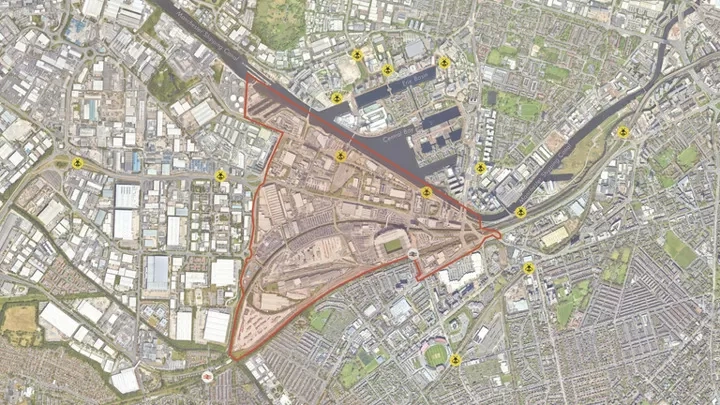
Manchester United have taken the most significant step yet in one of English football’s most ambitious infrastructure projects revealing the exact location of their proposed new 100000-seat stadium and releasing the first detailed visuals of what the ground and surrounding area could look like.
The announcement marks a pivotal moment not just for the club, but for an entire side of Greater Manchester that is set to be transformed beyond recognition over the coming decade.
Where Will Manchester United’s New Stadium Be Built?
The new stadium will be constructed approximately 350 metres north-west of the existing Old Trafford ground on a triangular parcel of land currently occupied by a go-kart track and several industrial units on the other side of the Manchester Ship Canal.
The site selection solves a geographical problem that has long complicated redevelopment plans at Old Trafford. The current stadium is hemmed in on all sides railway lines run alongside one edge and the canal sits just metres from one corner of the existing ground. There was simply no room to expand in place or regenerate at the necessary scale. Moving across the canal onto the new triangular site unlocks the capacity and scale ambitions United and their architects have in mind.
The club confirmed they had acquired most of the required land just over two weeks ago and with land ownership now largely in place, the masterplan has accelerated rapidly into public view.
The Wharfside Masterplan: More Than Just a Football Stadium
The new stadium is not being built in isolation. It forms the centrepiece of the far broader Trafford Wharfside Masterplan a major urban regeneration project that will reshape the entire area surrounding Old Trafford into a year-round destination for sport, entertainment and community living.
Key elements of the Wharfside Masterplan include:
Thousands of new homes built across the regenerated area, addressing Greater Manchester’s significant housing demand. Improved public transport links connecting the district more effectively to the wider city network. New walking and cycling infrastructure making the area more accessible to pedestrians and cyclists. Year-round sports and entertainment facilities turning what is currently a matchday-only destination into a genuinely active district seven days a week.
The images released alongside Thursday’s announcement show a dramatically reimagined waterfront though the club has been careful to note these visuals are not final and remain subject to change as designs are refined through the consultation process.
New Trafford: The Design Details
The new stadium referred to in internal briefing documents as ‘New Trafford’ is being designed with a striking visual identity that sets it apart from anything currently in English football.
Key design features include:
An umbrella roof structure that, according to the project’s architects, will harvest both solar energy and rainwater embedding sustainability into the fabric of the building from the ground up. Three landmark masts rising above the roofline, making the stadium visible from up to 40 kilometres away. In a detail that has already generated considerable debate, United believe the structure will be visible on a clear day from the outskirts of Liverpool. The New Stretford End alone will hold 23,500 supporters across lower and upper tiers larger than many complete football grounds across England. The stadium is expected to take five years to construct from the point ground is broken.
United plan to continue playing at the existing Old Trafford throughout the construction period, maintaining their matchday operations without interruption.
How Does It Compare? UK and European Rankings
The scale of the ambition becomes clear when you look at where this stadium would sit in the wider football landscape.
At 100,000 capacity, New Trafford would become:
The largest stadium in the United Kingdom overtaking Wembley Stadium, which holds 90,000. The second-largest club stadium in Europe behind only Barcelona’s Camp Nou, which is currently being expanded to 105,000 through its ongoing renovation works. A significant step up from Old Trafford’s current capacity of 74,879, adding over 25,000 additional seats.
For context, the New Stretford End alone at 23,500 would be larger than the entire capacity of grounds like Brentford’s Gtech Community Stadium (17,250) or Luton’s Kenilworth Road (10,356).
What Happens Next? The Planning Timeline
The project now moves into its formal approval and consultation phase. Here is how the timeline looks:
July 20 Trafford Council is set to consider and vote on the Wharfside Masterplan submission. July 28 – September 22 An eight-week public consultation period begins, with events across the area giving local residents and stakeholders the opportunity to view the plans and submit their views. Post-consultation Planning applications will be formally submitted, designs refined based on consultation feedback, and construction timelines established.
Nothing can move to ground level for at least a year given the requirement to complete consultations and secure full planning permission. The final architectural designs have not yet been locked in now that the site is confirmed, a formal design process incorporating fan input will begin in earnest.
The Target: Premier League Football Before 2035
Collette Roche, CEO of the New Stadium Development project, has publicly stated that the club’s ambition is to have a fully operational stadium in place ahead of a potential bid to host the 2035 Women’s World Cup but that personal ambition runs ahead of that.
“She wants it built sooner,” a source close to the project confirmed. “She wants Premier League football there before that date.”
Whether that timeline proves achievable depends entirely on the speed of planning approval, consultation outcomes and design finalisation. But the direction of travel is unambiguous Manchester United are committed to building the biggest and most ambitious stadium in British football history, and Thursday’s announcement makes clear that project is now moving from aspiration to reality.
A New Era for Old Trafford’s Neighbourhood
United have spent 115 years at Old Trafford. Whatever form the new stadium takes and whatever ultimately happens to the existing ground, a question the club has not yet answered the announcement of the location and masterplan marks a genuine turning point.
The Theatre of Dreams is preparing to build something bigger. And if the ambition matches the delivery, New Trafford could become not just the home of Manchester United, but one of the defining landmarks of 21st century British sport.