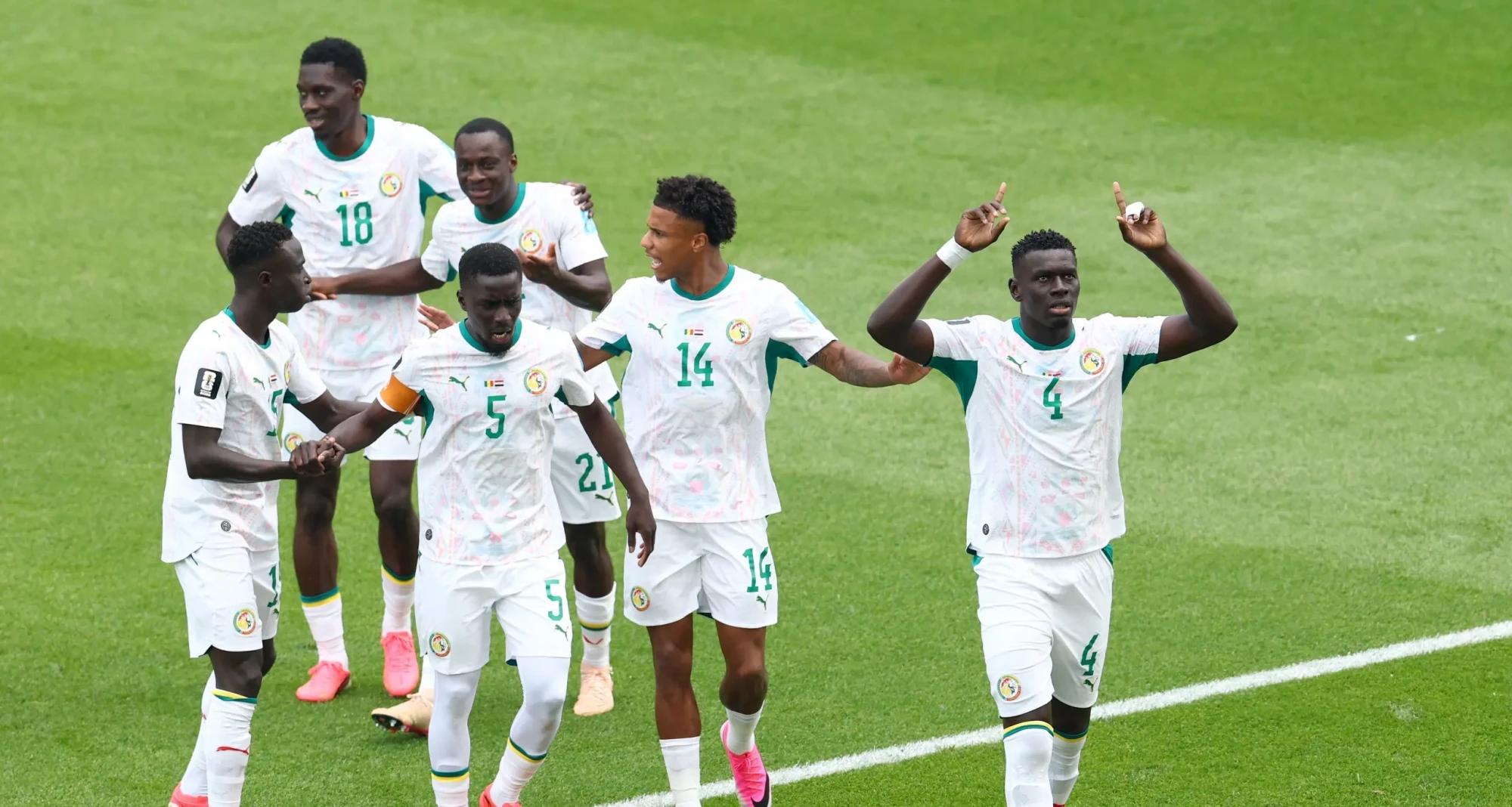
Three days ago, Senegal’s 2026 World Cup was effectively over. Back-to-back defeats against France and Norway had left the African champions staring at a group stage exit humiliated by the gap between their ambitions and their execution, their World Cup campaign appearing destined to end without a single win. Then came Toronto. Then came the Lions of Teranga’s most complete performance of the tournament.
A 5-0 demolition of Iraq powered by an early numerical advantage following a 13th-minute Iraqi red card, a lethal triple substitution that produced two goals within fifteen minutes of entering the pitch, and a stunning solo effort from Iliman Ndiaye has transformed Senegal’s tournament narrative completely. More importantly, it has flipped their goal difference from -3 to +2, potentially giving them the statistical floor needed to advance as one of the eight best third-placed teams in the expanded 48-team format.
For football fans across Kenya and the African continent following the Lions of Teranga, this was the moment the 2026 World Cup got genuinely exciting again.
📊 Senegal vs Iraq — 2026 World Cup Match Stats
- Final Score: Senegal 5-0 Iraq
- Venue: BMO Stadium, Toronto, Canada — June 26, 2026
- Goals: Diarra (4′), Sarr (56′), Pape Gueye (64′, 71′), Ndiaye (82′)
- Red card: Rebin Sulaka (Iraq) — straight red, 13th minute, denied obvious goal-scoring opportunity
- Senegal possession: ~65%
- Pape Gueye: 2 goals in 89 seconds after entering as substitute
- Ismaïla Sarr 2026 WC tally: 3 goals in the group stage
- Goal difference swing: -3 → +2 (a +5 swing in one match)
- Iraq red card: Sulaka hauled down Mané on the edge of the box — VAR confirmed straight red
Five-Star Lions: How Senegal Revived a World Cup That Was All But Dead
The pressure bearing down on Pape Thiaw’s Senegal as they walked out at BMO Stadium in Toronto was almost incomprehensible. A negative goal difference. Zero points. The knowledge that only a massive winning margin — combined with favourable results elsewhere — could keep their third-place qualification hopes alive. The Lions of Teranga needed nothing short of a footballing miracle. What they produced was something even better: a performance of tactical brilliance, squad depth, and relentless competitive spirit that left Iraq completely dismantled and the African football world erupting with pride.
From the first whistle, Senegal moved with the urgency and directness of a team that understood exactly what was required. Full-backs pushed high. Counter-press triggers activated immediately on every Iraq possession. The early goal came before four minutes were on the clock. The red card came before thirteen. From that moment, the narrative of the match was irreversible — Senegal were not merely going to win, they were going to win by the kind of margin that shifts goal difference tables and changes World Cup destinies.
First Half: Seck’s Header, Mané’s Red Card Force & Iraq’s 13th-Minute Collapse
Senegal found the opening goal with a directness and set-piece clarity that reflected the meticulous preparation Pape Thiaw had clearly invested in ahead of this must-win fixture. Inside the fourth minute, Idrissa Gueye’s long-range drive deflected slightly off a defender, wrong-footing Galíndez and forcing a corner. From the resulting set piece, imposing defender Abdoulaye Seck rose highest at the near post — redirecting the cross toward the six-yard box with controlled power. In the scramble that followed, Habib Diarra got the decisive touch, bundling the ball over the line in the frantic congestion to give Senegal the early lead their urgency had demanded.
If the first goal was about collective set-piece organisation, the match’s defining moment arrived nine minutes later through individual brilliance from the most experienced player on the pitch. Sadio Mané — the former Liverpool, Bayern Munich, and Al Nassr forward playing in what is surely his final World Cup — used his trademark burst of low-centre-of-gravity acceleration to intercept a loose Iraqi possession in the central corridor. He broke clean through, the goal ahead of him, the defenders behind him. Iraqi defender Rebin Sulaka faced an impossible decision — and made the only one available to him, hauling Mané down on the very edge of the penalty area.
The referee consulted VAR. The review was brief. The conclusion was unambiguous: straight red card for denying an obvious goal-scoring opportunity. Iraq were down to ten men before a quarter of the match had been played. Striker Ahmed Qasem was immediately sacrificed for defender Manaf Younis as the Iraqi coaching staff accepted that damage limitation was now the only realistic objective.
Was Sulaka’s red card the correct decision?
Yes — the VAR review confirmed that Rebin Sulaka’s foul on Mané was a clear denial of an obvious goal-scoring opportunity. Mané had broken completely clean through the central corridor with the goalkeeper as his only remaining obstacle. The straight red card was the correct application of the Laws of the Game, though the timing — with only thirteen minutes played and the match already at a decisive juncture for Senegal’s World Cup survival — made it a catastrophic moment for Iraq’s tournament.
Despite controlling nearly 65% of possession for the remainder of the first half, Senegal lacked the clinical sharpness to extend their lead before the interval. Mané fired multiple efforts over the bar in frustrating succession, and Iraq’s ten-man defensive organisation — compact, disciplined, and desperately motivated to deny Senegal the goal difference swing they so desperately needed — held out to reach half-time at just 1-0. The Lions needed their manager to find solutions at the break.
Zidane Iqbal’s Howler & Ismaïla Sarr’s Ruthless 56th-Minute Finish
The second half saw Senegal emerge with dramatically increased tempo — moving the ball horizontally at pace to exhaust Iraq’s shifting ten-man defensive block and create the wider spaces that their pacey forwards required. The breakthrough arrived courtesy of one of the most unexpected sources: a catastrophic error from one of Iraq’s highest-rated players.
Zidane Iqbal — the Manchester-born midfielder who has been one of Iraq’s standout performers in this tournament — attempted to play out from his own penalty area as Senegal pressed aggressively. The decision was misguided, and the execution was worse. Lamine Camara pounced on the turnover with the pressing aggression that Pape Thiaw had drilled into his midfield all week, driving into the penalty box before producing the unselfish decision that creates the easiest goals: a low square ball across the face of goal that required Ismaïla Sarr only to sweep home from a few yards.
The Watford winger converted with the composure of a player in form — his third goal of the 2026 World Cup group stage — and the stadium erupted as Senegal’s goal difference equation suddenly looked dramatically more achievable.
Pape Gueye’s Masterclass: Two World Cup Goals in 89 Seconds as a Substitute
What followed is already being described as one of the most extraordinary substitute cameos in World Cup history. With a two-goal cushion established and the match entering its final third, Pape Thiaw made a triple substitution that completely transformed an efficient victory into a five-star, goal-difference-defining blowout. Pape Gueye entered the pitch for Habib Diarra — and left an immediate, indelible stamp on the fixture.
Just 89 seconds after crossing the touchline, Gueye had his first World Cup goal. Intercepting a desperate Iraqi clearance on the edge of the penalty area, he set himself with a single, controlled touch — then lashed a phenomenal, dipping left-footed strike from the edge of the box directly into the top left corner of the net. The technique was extraordinary: the kind of finish that requires not just ability but the composure to execute at the highest level within ninety seconds of entering a match of this magnitude.
But Gueye was not remotely finished. In the 71st minute — just seven minutes after his first strike — the ball sat up beautifully for him following another sustained Senegalese attacking wave. Without hesitation, Gueye hammered a fierce, low-driven rocket past substitute goalkeeper Jalal Hassan, who had replaced the original keeper following a knock, to make it 4-0. Two goals. Fifteen minutes on the pitch. One of the most impactful substitute performances of the entire 2026 World Cup tournament.
How quickly did Pape Gueye score after coming on as a substitute?
Pape Gueye scored his first goal just 89 seconds after entering the pitch as a substitute — one of the fastest substitute goals in World Cup history. He then added a second just seven minutes later to complete a brace that fundamentally transformed Senegal’s goal difference and their third-place qualification chances in a single fifteen-minute cameo.
Ndiaye’s Solo Rocket Caps Senegal’s Five-Star Statement
The final act of Senegal’s extraordinary evening arrived in the 82nd minute — and it was the most aesthetically spectacular of all five goals. Iliman Ndiaye — one of Senegal’s most talented attackers — collected the ball near the halfway line with two exhausted Iraqi defenders between him and the goal. Rather than passing to an available teammate, Ndiaye chose to take them on.
What followed was a dazzling, solo diagonal run that carved through Iraq’s remaining defensive structure — leaving two defenders in his wake with a combination of close control, rapid direction changes, and the acceleration that makes him impossible to track when operating at full pace. He drilled a powerful shot in at the near post, giving Hassan no angle and no chance, to confirm the extraordinary 5-0 final scoreline. Five goals. One match. A tournament resurrection that the African football world will not forget.
What This Result Means: Senegal’s Third-Place Qualification Explained
The football was thrilling — but for Pape Thiaw and his coaching staff, the result carried a significance that transcended goals and individual moments. The primary mission entering this match was a goal difference transformation, and Senegal delivered it with emphatic precision.
The numbers tell the story clearly:
- Before the match: Senegal — 0 points, -3 goal difference, effectively eliminated
- After the match: Senegal — 3 points, +2 goal difference — a swing of +5 in a single match
- Third-place table position: Senegal’s +2 goal difference places them among the more competitive third-placed sides — the positive swing is crucial
- The format advantage: In the expanded 48-team World Cup, eight of the twelve third-placed teams advance to the Round of 32 — giving Senegal a genuine mathematical lifeline
Whether the 5-0 win is sufficient depends entirely on results from other groups. Several third-placed sides are level on three points — and goal difference will be the decisive tiebreaker. Senegal’s +2 is now one of the strongest goal differences among the three-point third-placed teams, giving them a realistic platform to survive if the other results fall their way.
Final Group I Third-Place Impact & Scotland’s Anxious Wait
Senegal’s 5-0 win has had immediate and dramatic consequences for the third-place qualification table — directly affecting the survival chances of other teams waiting on results. Most significantly, Scotland — who sat eighth in the third-place standings before the Toronto result — have been pushed into an even more precarious position by Senegal’s goal difference improvement.
📊 Final Group I Standings
| Pos | Team | P | W | D | L | GD | Pts |
|---|---|---|---|---|---|---|---|
| 1 | 🇫🇷 France | 3 | 3 | 0 | 0 | +8 | 9 |
| 2 | 🇳🇴 Norway | 3 | 2 | 0 | 1 | +1 | 6 |
| 3 | 🇸🇳 Senegal | 3 | 1 | 0 | 2 | +2 | 3 |
| 4 | 🇮🇶 Iraq | 3 | 0 | 0 | 3 | -11 | 0 |
Senegal’s final third-place standing depends entirely on whether their three points and +2 goal difference is sufficient once all twelve groups complete their final matchday fixtures on June 27-28. The Lions of Teranga have done everything within their power to keep the dream alive. The football world now watches and waits.
Frequently Asked Questions: Senegal vs Iraq 2026 World Cup
What was the score of Senegal vs Iraq at the 2026 World Cup?
Senegal defeated Iraq 5-0 at BMO Stadium in Toronto on June 26, 2026. The goals came from Habib Diarra (4′), Ismaïla Sarr (56′), Pape Gueye (64′, 71′), and Iliman Ndiaye (82′). Iraq played the entire second half with ten men following Rebin Sulaka’s straight red card in the 13th minute.
Who scored for Senegal against Iraq?
Senegal’s five goals were scored by Habib Diarra (4′ — scrambled finish from a corner), Ismaïla Sarr (56′ — composed finish after Zidane Iqbal’s turnover), Pape Gueye (64′ — stunning top-corner drive and 71′ — fierce low rocket, both within 15 minutes of coming on as a substitute), and Iliman Ndiaye (82′ — solo run and near-post finish).
Why was Iraq reduced to 10 men against Senegal?
Iraqi defender Rebin Sulaka received a straight red card in the 13th minute after hauling down Sadio Mané, who had broken completely clean through the central corridor with only the goalkeeper to beat. VAR confirmed it was a clear denial of an obvious goal-scoring opportunity — the correct decision under the Laws of the Game.
Can Senegal qualify for the 2026 World Cup Round of 32?
Yes — Senegal are in contention to qualify as one of the eight best third-placed teams in the expanded 48-team format. Their 5-0 win transformed their goal difference from -3 to +2, giving them 3 points and a positive goal difference that places them strongly among the third-place contenders. Whether they advance depends on final results from other groups completing on June 27-28.
How quickly did Pape Gueye score after coming on as a substitute?
Pape Gueye scored his first goal just 89 seconds after entering the pitch as a substitute — a stunning top-corner left-footed drive from the edge of the box. He then added a second goal in the 71st minute — just seven minutes after his first — to complete one of the most explosive substitute performances in 2026 World Cup history.
What does Senegal’s 5-0 win mean for the third-place table?
Senegal’s 5-0 win over Iraq improved their goal difference by five in a single match — from -3 to +2 — and moved them from the bottom of the third-place standings to a competitive position with three points. Their +2 goal difference is now among the stronger figures for three-point third-placed teams, giving them a genuine mathematical chance of advancing to the Round of 32. Visit the FIFA official website for live third-place standings and confirmed qualifying teams. Kenyan fans can follow all results live on DStv SuperSport.