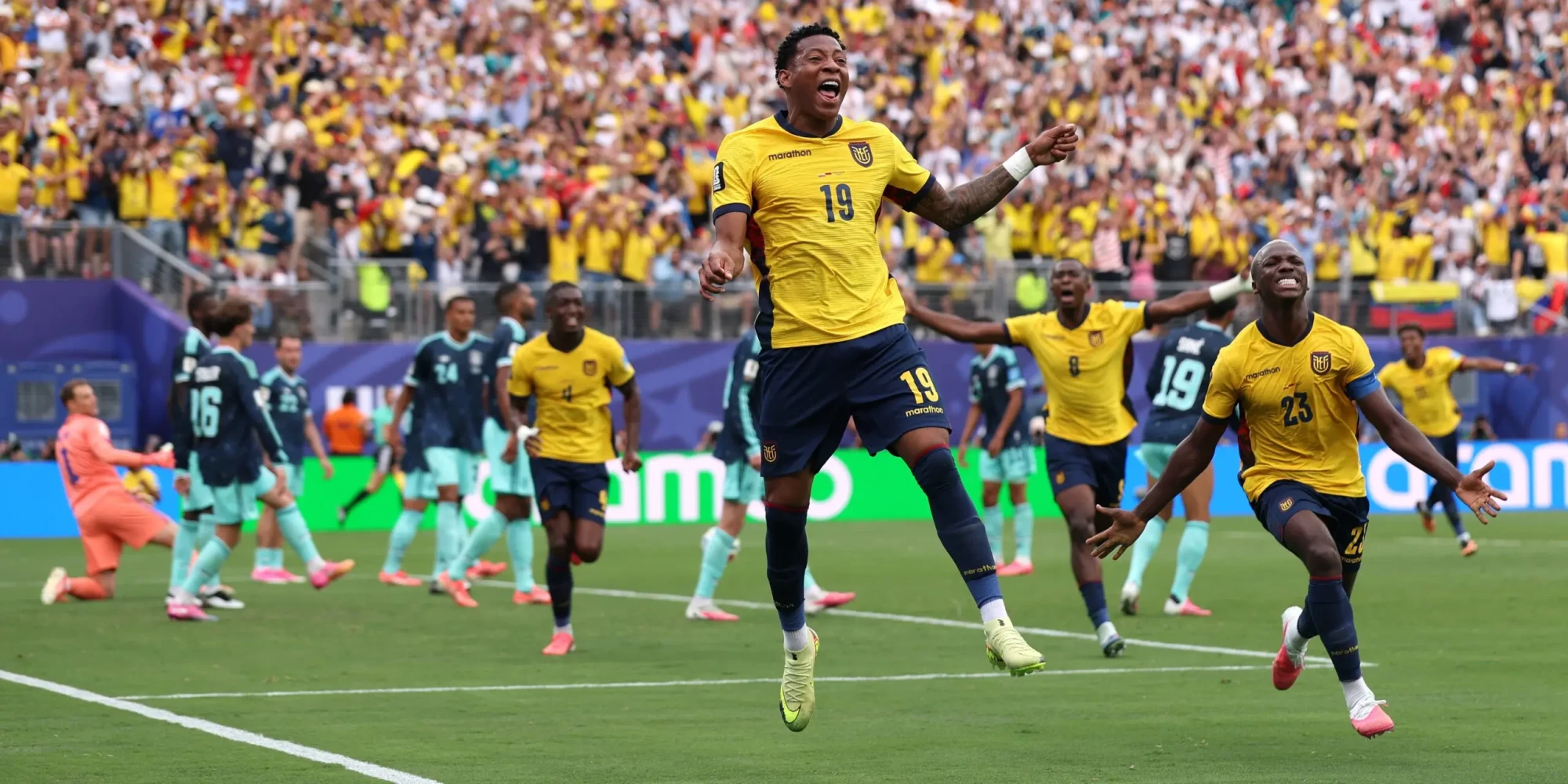
Football has a habit of humbling its most celebrated participants at the least expected moments and the 2026 FIFA World Cup has just produced its most stunning upset. On the final matchday of Group E at the MetLife Stadium in New Jersey, Ecuador delivered a breathtaking 2-1 victory over Germany sending shockwaves through the entire tournament bracket and serving notice on every remaining contender that La Tri are not in North America to make up the numbers.
Julian Nagelsmann’s side tournament heavyweights who had dismantled Curaçao 7-1 in their opening fixture were brilliantly outmanoeuvred by Sebastián Beccacece’s tactically immaculate Ecuador. Leroy Sané struck in the 2nd minute to give Germany what looked like a platform for another dominant performance. But Nilson Angulo’s instant 9th-minute counter reset the psychological momentum entirely and Gonzalo Plata’s 77th-minute winner completed one of the 2026 World Cup’s great upsets. For football fans across Kenya and the entire African continent watching every moment of this extraordinary tournament, this was the result that changes everything.
📊 Germany vs Ecuador — 2026 World Cup Match Stats
- Final Score: Germany 1-2 Ecuador
- Venue: MetLife Stadium, New Jersey, USA — June 25, 2026
- Goals: Sané (2′), Angulo (9′), Plata (77′)
- Germany possession: ~60%
- VAR incident: Germany penalty overturned — clean tackle confirmed
- Yellow cards: Hincapié (Ecuador), Pavlović (Germany, subbed off), Plata (89′)
- Key subs: Stiller for Pavlović (HT); Undav & Thiaw for Germany; Estupiñán & K. Rodríguez for Ecuador
- Ecuador defensive duo: Pacho & Ordóñez — immovable in the final ten minutes
- Group E impact: Ecuador advance to Round of 32; Germany’s seeding affected
The Shock of Group E: How Ecuador Dismantled One of the World Cup’s Favourites
To understand the magnitude of this result, the context must be established clearly. Germany arrived at the final Group E matchday as the division’s overwhelming leaders six points from six, a +6 goal difference after their 7-1 demolition of Curaçao, and the kind of tournament form that had placed them firmly among the pre-tournament favourites. Ecuador, conversely, were the supposedly weaker opponent a South American side whose defining quality had been defensive resilience rather than attacking brilliance.
The scoreline that followed rendered that narrative completely obsolete. Ecuador did not merely beat Germany they outplayed them tactically, outran them physically in the final thirty minutes, and executed Beccacece’s game plan with a discipline and intelligence that the world’s top-ranked teams would be proud to replicate.
The result means Ecuador advance to the Round of 32 with their tournament reputation dramatically enhanced. Germany still progress but their seeding and psychological confidence heading into the knockout rounds have taken a significant hit from a defeat they will be analysing for weeks.
Sané’s 2nd-Minute Opener: Germany’s Dream Start That Proved Dangerously Deceptive
The opening two minutes appeared to confirm every pre-match prediction. Germany immediately took control of the ball with the crisp, horizontal passing sequences that had been so devastating in the Curaçao fixture stretching Ecuador’s defensive shape horizontally before creating the vertical passing lanes that their creative midfield demands.
In the 2nd minute, the move arrived with devastating precision. Jamal Musiala threaded an incisive diagonal pass through the half-space, cutting open Ecuador’s compact defensive lines with a ball that demanded a first-time finish. Leroy Sané timed his back-door run to perfection, latching onto the delivery and driving a clinical, low shot across Hernán Galíndez into the bottom corner. Germany 1-0. The German fans erupted. The floodgates, it seemed, were open.
It was a goal of genuine quality a move that showcased exactly why Germany’s combination of Musiala’s vision and Sané’s movement made them so dangerous in transition. But the early lead would prove to be one of the most misleading advantages in the entire 2026 tournament. Ecuador had a response prepared and it arrived within seven minutes.
Angulo’s Instant Counter: How Ecuador’s 9th-Minute Equaliser Changed Everything
Rather than retreating into damage limitation after conceding, Ecuador did precisely what Beccacece had designed them to do in their pre-match preparation: they immediately intensified their counter-pressing, targeting the spaces behind Germany’s high defensive line that the South American coaching staff had identified as their primary route to goal.
The strategy produced its reward in the 9th minute a move that in retrospect defined the entire match. Moises Caicedo intercepted a loose ball in midfield with the reading of play that makes him one of the most sought-after defensive midfielders in world football. Rather than slowing the tempo, Caicedo immediately launched a direct counter pushing the ball through the central corridor at pace and releasing Nilson Angulo on the edge of the Germany penalty area.
What followed was a moment of remarkable composure from a young attacker on the biggest stage of his career. Angulo received the ball facing the Germany goal with Antonio Rüdiger closing at pace. Rather than rushing his shot, he shifted his body weight to create just a yard of space and then drove a powerful, precise strike past Manuel Neuer to level the score at 1-1. The stadium erupted in yellow noise. Psychologically, Germany’s early advantage had been completely erased.
Who is Nilson Angulo and why is his goal so significant?
Nilson Angulo is one of Ecuador’s most dangerous young attacking players direct, physically powerful, and technically capable of finishing under pressure against elite-level opposition. His 9th-minute equaliser against Germany demonstrated exactly the qualities that make him a genuine threat at the highest level: the composure to take a touch under pressure from Rüdiger, the technical ability to shift his weight and create space in a congested area, and the finishing quality to convert against one of the world’s best goalkeepers. It was a goal that will be remembered for years in Ecuadorian football history.
The Tactical Stalemate: How Ecuador Strangled Wirtz, Musiala & Germany’s Creative Engine
Following the explosive opening ten minutes, the match transformed into a tactical chess match that Ecuador won convincingly. Beccacece’s side shifted into an incredibly compact defensive block reorganising their shape to deny Germany the central progressive passing lanes that Florian Wirtz and Jamal Musiala require to operate most dangerously.
The defensive structure was brilliantly executed. Germany commanded nearly 60% of possession across the first half but the raw statistics concealed a reality of sterile, sideways movement that generated almost nothing of genuine danger. Whenever Wirtz attempted to receive between Ecuador’s defensive and midfield lines, he was immediately surrounded by compact pressing cover. Whenever Musiala drove at the Ecuador backline from wide, overlapping wing-backs doubled him before he could enter the penalty area.
Germany’s best opportunity before half-time came from a different source entirely. Kai Havertz rose highest to meet a David Raum cross but his header lacked the necessary placement and power to beat Galíndez. As the teams entered the break level at 1-1, Ecuador’s coaching staff had reason to be deeply satisfied. Their team had absorbed Germany’s opening burst and successfully suffocated the creativity of the tournament’s second-highest-ranked side. The second half would belong to the team with the fresher legs and the more adaptable game plan.
VAR Denies Germany Penalty: The Decisive Second-Half Turning Point
Nagelsmann’s primary half-time adjustment was the replacement of the cautioned Aleksandar Pavlović with Angelo Stiller a change designed to restore midfield fluidity and reduce the risk of a second yellow card that would have left Germany with ten men at a critical moment. The German manager was also visibly communicating more direct tactical instructions to his wide players, demanding earlier delivery into Havertz rather than the wide combination play that Ecuador’s defensive structure had nullified.
The second half nearly swung decisively in Germany’s favour when the referee pointed to the penalty spot following a challenge on a German attacker inside the Ecuador penalty area. The tension in MetLife Stadium was immediate and electric. But a lengthy VAR review intervened and the pitchside screen revealed that the Ecuador defender had cleanly won the ball before making contact with the German forward. The penalty was overturned. Germany’s momentum was broken. Ecuador immediately re-engaged their aggressive defensive press with renewed conviction.
The VAR moment was a turning point not merely in its direct outcome but in what it did psychologically to both sides. Ecuador’s players, having survived what appeared to be a penalty against them, visibly increased their intensity and belief. Germany’s players, frustrated by the overturned decision, began showing the irritation and impatience that disrupts defensive concentration. The game was turning and Ecuador could feel it.
Gonzalo Plata’s 77th-Minute Winner: Ecuador Complete One of the 2026 World Cup’s Greatest Upsets
As the match entered its final twenty minutes, Beccacece made the decisive substitutions that would shape the outcome. Pervis Estupiñán and Kevin Rodríguez arrived to maintain fresh legs along the flanks, with Beccacece explicitly targeting the spaces behind Germany’s increasingly high defensive positioning Nagelsmann’s men committing more numbers forward in their search for a winning goal.
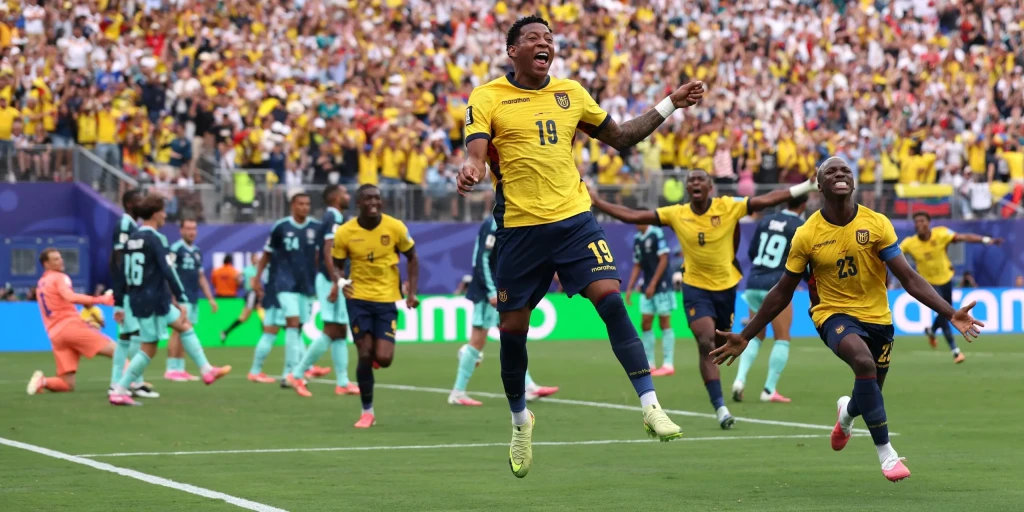
The decisive move came in the 77th minute. Ecuador won a corner from a deep defensive sequence and from the resulting set piece, the ball broke loose in the penalty area after an aerial challenge fell to Gonzalo Plata. The Ecuadorian winger showed remarkable instinct, poking the ball across the goal line just ahead of a recovering Manuel Neuer. 2-1 Ecuador. New Jersey erupted in yellow.
The final ten minutes were a masterclass in defensive organisation and collective will. Germany threw absolutely everything forward direct long balls, overloaded box deliveries, desperate wide overloads. But the central defensive partnership of Willian Pacho and Joel Ordóñez stood completely firm, winning every aerial duel, blocking every through-ball, and denying Germany even a single clear chance to equalise. When Plata received a yellow card in the 89th minute for a tactical foul to halt Germany’s final surge, it symbolised Ecuador’s total commitment a team prepared to sacrifice everything for the most significant result in their recent World Cup history.
When the final whistle blew, the scenes were extraordinary. Ecuador’s players piled on top of each other in disbelief and joy. Their supporters created a wall of noise in MetLife Stadium. Beccacece ran onto the pitch with arms raised. And Germany the four-time world champions, the 7-1 destroyers of Curaçao walked off having been convincingly outplayed by a side that arrived in New Jersey as significant underdogs. This was the 2026 World Cup’s most shocking result. And Ecuador had earned every second of it.
Group E Fallout: The Knockout Stage Picture Completely Redrawn
The implications of Ecuador’s victory extend far beyond their own tournament position. The result has completely reshuffled the Group E final standings and altered the knockout stage seedings in ways that will ripple through the entire bracket.
📊 Final Group E Standings
| Pos | Team | P | W | D | L | GD | Pts |
|---|---|---|---|---|---|---|---|
| 1 | Germany | 3 | 2 | 0 | 1 | +5 | 6 |
| 2 | Ivory Coast | 3 | 2 | 0 | 1 | +1 | 6 |
| 3 | Ecuador | 3 | 1 | 1 | 1 | 0 | 4 |
| 4 | Curaçao | 3 | 0 | 1 | 2 | -6 | 1 |
Germany top on goal difference over Ivory Coast (both 6 points). Ecuador qualify as a third-placed team with 4 points. Curaçao are eliminated.
Germany still top Group E on goal difference over Ivory Coast but their loss to Ecuador has dented the invincibility that their Curaçao demolition created and handed the knockout stage’s rival coaches a detailed blueprint for how to contain Musiala, Wirtz, and Havertz under pressure. Ecuador’s four points as a third-placed team virtually guarantee their place in the Round of 32 where they will arrive as one of the tournament’s most dangerous dark-horse opponents.
For the teams awaiting Ecuador in the knockout rounds whoever they face in the Round of 32 and potentially beyond the Germany result carries an unmistakable warning. Beccacece’s side are organised, physically relentless, tactically brilliant in transition, and capable of defeating any team on earth when their game plan is executed at this level. The World Cup’s best dark horse just made their most emphatic statement of intent.
Frequently Asked Questions: Ecuador vs Germany 2026 World Cup
What was the score of Ecuador vs Germany at the 2026 World Cup?
Ecuador defeated Germany 2-1 in their Group E final matchday fixture at MetLife Stadium in New Jersey on June 25, 2026. Leroy Sané gave Germany an early lead in the 2nd minute, but Nilson Angulo equalised in the 9th minute before Gonzalo Plata’s 77th-minute winner sealed Ecuador’s famous victory.
Who scored Ecuador’s goals against Germany?
Ecuador’s two goals were scored by Nilson Angulo in the 9th minute a composed counter-attacking finish after a Moises Caicedo interception and Gonzalo Plata in the 77th minute, who poked home from close range after an aerial challenge fell to him from a corner routine.
Did Germany qualify from Group E despite losing to Ecuador?
Yes — Germany still topped Group E despite their 2-1 defeat to Ecuador. With Ivory Coast also winning their final group game, both Germany and Ivory Coast finished on 6 points, with Germany advancing as group winners on superior goal difference (+5 vs +1). Ecuador qualified as a best third-placed team with 4 points.
Was there a VAR controversy in Germany vs Ecuador?
Yes — a penalty was awarded to Germany in the second half but overturned by VAR after a lengthy review confirmed that the Ecuador defender had cleanly won the ball before making contact with the German attacker. The overturned decision proved to be a major psychological turning point in the match, with Ecuador immediately re-engaging their defensive press before scoring the winner fourteen minutes later.
How did Ecuador contain Musiala and Wirtz?
Ecuador coach Sebastián Beccacece deployed a compact defensive block that systematically denied Musiala and Wirtz the space between the lines they need to operate most dangerously. Ecuador’s overlapping wing-backs doubled Germany’s wide attackers whenever they received the ball, while their central midfield trio compressed the progressive passing corridors. Germany commanded 60% possession but generated almost nothing of genuine danger in the first half as a result.
What does Ecuador’s win over Germany mean for the knockout stages?
Ecuador’s victory over Germany confirms their place in the Round of 32 as a best third-placed team and establishes them as one of the tournament’s most dangerous dark-horse opponents. Their ability to absorb possession, execute lethal counter-attacks, and defend resiliently in the final minutes against a top-five nation sends a direct warning to every team remaining in the 2026 World Cup. Visit the FIFA official website for confirmed Round of 32 fixtures and kickoff times. Kenyan fans can watch all matches live on DStv SuperSport.