For over a decade, Miroslav Klose’s record of 16 World Cup goals stood as the most untouchable individual achievement in the tournament’s history a standard set across four World Cups between 2002 and 2014 that seemed destined to endure for a generation. On the evening of June 22, 2026, in Dallas, Texas, the record fell.
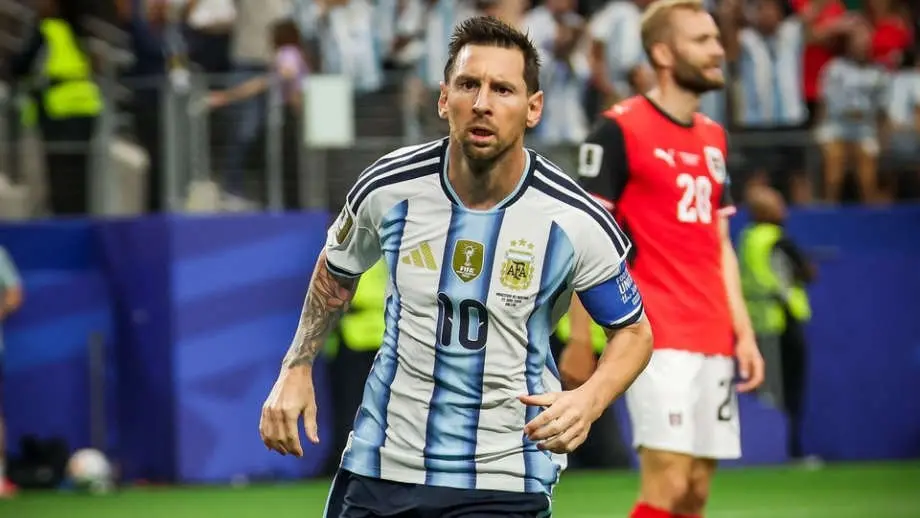
In the 38th minute, Messi received the ball in a position he has made entirely his own across 38 years of football between the lines, facing goal, with a defender at his shoulder and the weight of history bearing down. He took one touch to set himself, found the angle, and struck a beautifully executed finish past Alexander Schlager. The ball hit the net. The stadium erupted. And Lionel Messi became the men’s World Cup’s all-time top goalscorer with his 16th tournament goal equalling Klose in the moment of the strike before confirming the outright record with his second in stoppage time.
The second goal came in the 94th minute, as Argentina absorbed Austria’s late pressure and broke with devastating counter-attacking precision. Messi involved in the transition, denied initially by Schlager recovered the loose ball and converted with a fierce, composed finish that made it 17 career World Cup goals. The record was his, alone, permanently. History had been made in Dallas.
The achievement is almost incomprehensible in its scope. Messi has now scored World Cup goals across multiple tournament cycles, from his early appearances as a raw young talent to this final chapter as a 38-year-old captain in his sixth and last World Cup. No man in the history of the men’s game has scored more.
How many World Cup goals does Messi have now?
Following his brace against Austria, Lionel Messi has scored 17 goals in men’s World Cup football the most by any player in the tournament’s history. He surpassed Miroslav Klose’s previous record of 16, which had stood since the German’s retirement after the 2014 World Cup. Messi also has five goals in the 2026 tournament alone after just two group stage appearances.
First Half: Missed Penalty, Laimer’s Press & Messi’s History-Making 38th-Minute Strike
The opening exchanges at AT&T Stadium offered little indication that history was about to be made. Argentina began the match with the composed assurance of the reigning world champions but their authority was immediately tested by a Ralf Rangnick-engineered pressing system that refused to allow the South Americans any comfort on the ball.
The match’s first major moment of drama arrived in just the 9th minute. A VAR review confirmed a penalty for Argentina a golden opportunity to take an early lead against a defensively organized European side. The chance was wasted emphatically, the strike scuffed well wide of Alexander Schlager’s post to audible groans from the Dallas crowd. It was the kind of miss that can shift momentum and for a brief period, it did exactly that.
Austria’s response to the penalty miss was immediate and energetic. Konrad Laimer and Nicolas Seiwald led an intense midfield press that choked Argentina’s central passing lanes, isolating the attacking line and forcing rare turnovers from the world’s top-ranked side. The European champions’ transition play was sharp and purposeful creating the genuine impression that a clean sheet was within their reach if the defensive structure held.
Argentina’s response to adversity came in the only form that matters at a World Cup: individual quality. In the 38th minute, a beautifully constructed buildup sequence created the space Messi needed and he took it with the conviction of a player who understood the magnitude of the moment he was about to create.
Second Half: Rangnick’s Bold Gamble, Scaloni’s Masterclass & Messi’s Stoppage-Time Sealer
Austria emerged for the second half with renewed energy and tactical ambition. Rangnick’s half-time adjustments reflected the urgency of a side that knew a draw from this position was achievable and would keep their knockout qualification firmly in their own hands. He introduced Patrick Wimmer and Carney Chukwuemeka to provide fresh legs and additional creativity in the areas where Argentina had looked most vulnerable during the first-half pressing sequences.
The changes forced Argentina onto the back foot for extended periods. Cristian Romero and Lisandro Martínez were tested repeatedly by Austria’s renewed attacking intent the combination of direct running from Wimmer and Chukwuemeka’s intelligent movement between the lines creating genuine anxiety in the South American defence that had not existed in the first period.
Lionel Scaloni’s response demonstrated exactly why he is considered one of the most tactically astute coaches at this tournament. Rather than exposing his side to further pressure, the Argentina head coach made a composed double substitution introducing Leandro Paredes to anchor the midfield center and Nicolás Tagliafico to neutralize Austria’s width a pair of changes that immediately stabilized Argentina’s defensive shape and restored the control they had temporarily lost.
As Austria committed numbers forward in the search for a late equalizer that would have transformed the Group J picture, they left exactly the transition space that Argentina have exploited with devastating efficiency throughout the 2026 tournament. Deep into stoppage time, a rapid counter-attack led to Messi’s initial shot being saved by Schlager but the Argentine captain recovered the loose ball instantly and converted with a powerful, composed finish to seal 2-0 and 17 World Cup goals.
What tactical adjustments did Scaloni make against Austria?
Scaloni’s double substitution of Paredes and Tagliafico was the decisive tactical intervention of the match restoring midfield control that Austria’s pressing had disrupted and eliminating the wide threat that Wimmer was creating from Rangnick’s changes. The substitutions reflected tournament-level management: prioritising defensive stability and transitional quality over chasing a bigger winning margin, trusting the squad’s counter-attacking excellence to deliver the second goal when the right moment arrived.
Tactical Breakdown: How Austria Made Argentina Suffer Before Breaking
The tactical dimension of Argentina vs Austria deserves deeper examination because for significant stretches of both halves, Ralf Rangnick’s side matched the world champions in a way that few Group J observers had anticipated before kickoff.
Austria’s pressing system was built around two non-negotiable principles:
- Laimer and Seiwald’s midfield press: The pair coordinated their press triggers with exceptional synchronisation — applying pressure to Argentina’s centre-backs and double pivot simultaneously, collapsing the central passing lanes that Enzo Fernández and Alexis Mac Allister depend on to distribute the ball progressively
- Compact defensive block: When the press was bypassed, Austria dropped into an organized mid-block that denied Argentina the space between the lines that Messi requires to operate most effectively forcing him to receive the ball deeper than he ideally wants and limiting his direct contributions for long stretches
The system worked well enough to keep Argentina to a single first-half goal and create genuine anxiety throughout the second period. However, the fundamental limitation of pressing systems against elite opposition is their energy cost and by the 85th minute, the Austrian press was operating at a fraction of its first-half intensity, creating precisely the transitional spaces that led directly to Messi’s 94th-minute sealer.
Five Goals in Two Games: Messi’s Extraordinary 2026 World Cup Campaign in Numbers
The full picture of Messi’s 2026 World Cup campaign is as staggering as anything produced by any player at any tournament in recent memory. In just two Group J appearances, the Argentine captain has accumulated a goal return that would represent a complete tournament’s output for most elite international forwards.
- Goals vs Algeria (Game 1): Hat-trick — 3 goals
- Goals vs Austria (Game 2): Brace — 2 goals
- 2026 tournament total: 5 goals in 2 games
- Career World Cup total: 17 goals — new all-time men’s record
- Previous record holder: Miroslav Klose — 16 goals (2002-2014)
The narrative context elevates the statistics even further. Messi is 38 years old at this World Cup playing in his sixth and almost certainly final tournament. The idea that a player at that age could open a World Cup with a hat-trick and then add a record-breaking brace in the following match is the kind of storyline that football’s greatest writers would reject as too implausible for fiction. And yet here we are, watching it happen in real time.
For the millions of football fans across Kenya and the African continent who have followed Messi’s career from its beginning, this tournament represents the final chapter of the defining individual story in the history of the sport. Witness it while it lasts.
Group J Standings: Argentina Top the Group, Austria’s Fate Hangs on Final Game
The result leaves Group J’s picture sharply defined heading into the final round of fixtures. Argentina’s maximum six points from six guarantee them first place in the group and the top seed advantage that comes with it giving Scaloni’s side the most favorable possible positioning for the Round of 32 draw.
📊 Group J Standings After Matchday 2
- 1st — Argentina: 2 played, 2 wins, 0 draws, 0 losses — 6 points (qualified)
- 2nd — Austria: 2 played, 1 win, 0 draws, 1 loss — 3 points
- 3rd — Algeria: 2 played, 0 wins, 1 draw, 1 loss — 1 point
- 4th — Jordan: 2 played, 0 wins, 1 draw, 1 loss — 1 point
Final Group J fixtures (June 28): Algeria vs Austria | Jordan vs Argentina both simultaneous kickoffs
For Austria, the situation remains entirely within their control. Having secured three points from their opening win against Jordan, Rangnick’s side need only replicate the defensive structure and physical intensity they showed against Argentina in their final group game against Algeria to secure knockout qualification. Their performance in Dallas despite the defeat demonstrated enough quality and organization to make them a genuine threat in the Round of 32 if they advance.
Frequently Asked Questions: Argentina vs Austria 2026 World Cup
What was the score of Argentina vs Austria at the 2026 World Cup?
Argentina defeated Austria 2-0 in their Group J fixture at AT&T Stadium in Dallas on June 22, 2026. Both goals were scored by Lionel Messi the first in the 38th minute and the second in the 94th minute with the brace confirming Argentina’s maximum six points from two group games.
Did Messi break the World Cup goals record against Austria?
Yes. Lionel Messi broke the all-time men’s World Cup goalscoring record against Austria, becoming the first player in history to score 17 goals in men’s World Cup football. His first goal against Austria equalled Miroslav Klose’s previous record of 16. His 94th-minute second goal gave him sole possession of the record permanently.
How many World Cup goals has Messi scored in total?
Following his brace against Austria, Lionel Messi has scored 17 goals in men’s World Cup history the most ever recorded by a player in the men’s tournament. In the 2026 World Cup alone, he has scored five goals across just two group stage appearances, having previously netted a hat-trick against Algeria in Game 1.
What was Miroslav Klose’s World Cup goals record before Messi?
German striker Miroslav Klose held the men’s World Cup goalscoring record with 16 goals, scored across four tournaments between 2002 and 2014. His record had stood for 12 years before Messi equalled and then surpassed it during Argentina’s Group J win over Austria at the 2026 World Cup in Dallas.
Has Argentina qualified from Group J at the 2026 World Cup?
Yes Argentina have qualified from Group J with a perfect six points from their first two group games, guaranteeing them top spot in the group and progression to the Round of 32. Their final group fixture is against Jordan on June 28. Visit the FIFA official website for confirmed Group J standings and knockout stage draw details.
What group are Argentina in at the 2026 World Cup?
Argentina are in Group J of the 2026 FIFA World Cup alongside Algeria, Austria, and Jordan. After two games, Argentina have six points and are guaranteed to top the group. Austria are second with three points heading into their final group fixture against Algeria on June 28.