
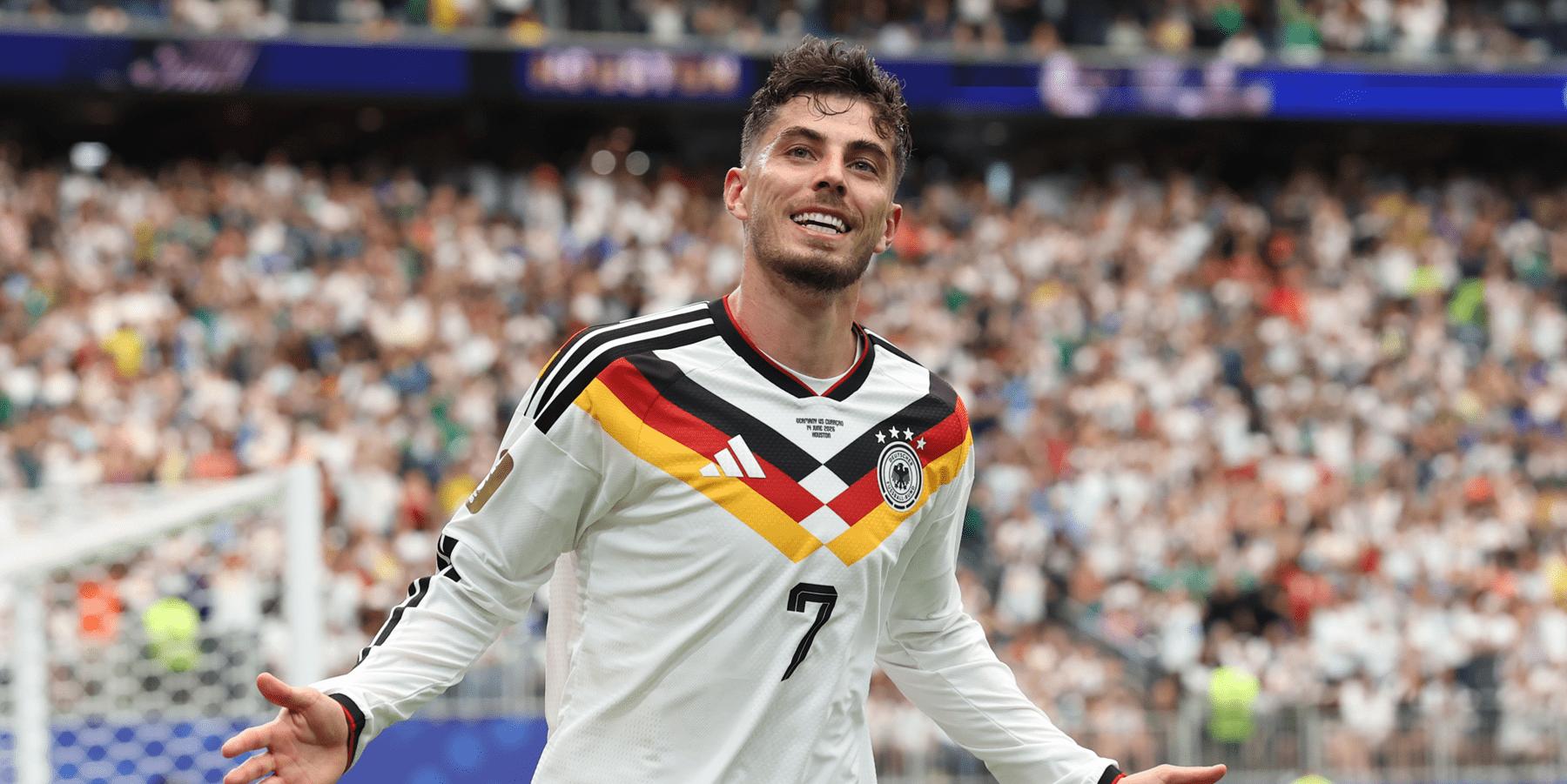
Four-time world champions Germany delivered the most emphatic statement of the 2026 FIFA World Cup group stage so far but the night in Houston will be remembered for far more than a routine heavyweight victory. In a breathtaking 7-1 demolition of World Cup debutants Curaçao at NRG Stadium, Julian Nagelsmann’s side were momentarily rocked by the tournament’s most emotional moment of the opening round: Livano Comenencia’s equaliser the smallest nation in World Cup history scoring their first ever goal on the global stage.
Germany ultimately reasserted their authority with a devastating second-half display featuring six different scorers, a Kai Havertz brace, and a historic night for returning goalkeeper Manuel Neuer, who at 40 years old became the oldest German international to feature at a major tournament. For football fans in Kenya and across Africa, this was a World Cup night that had everything.
📊 Germany vs Curaçao — 2026 World Cup Match Stats
- Final Score: Germany 7-1 Curaçao
- Venue: NRG Stadium, Houston, USA June 14, 2026
- Goals: Nmecha (6′), Comenencia (21′), Schlotterbeck (38′), Havertz pen (45+2′), Musiala (47′), Brown (68′), Undav (78′), Havertz (88′)
- Germany scorers: 6 different players
- Historic first: Comenencia scores Curaçao’s first ever World Cup goal
- Possession: Germany 65%
- Neuer record: Oldest German international at a major tournament 40 years, 79 days
- Group E standing: Germany top with 3 points, +6 goal difference
Curaçao’s Historic Moment: The First Ever World Cup Goal for the Smallest Nation in History
Before the goals, the records, and the avalanche of second-half German quality, the moment that defined the night in Houston belonged not to the four-time world champions but to the Caribbean island of Curaçao.
In the 21st minute, midfielder Livano Comenencia seized on a moment of defensive uncertainty in the German backline, taking a loose ball and driving a low, left-footed effort through a crowded penalty area. The shot took a subtle deflection and nestled beyond the dive of Manuel Neuer and the travelling Curaçao supporters erupted with a joy that transcended football entirely.
It was Curaçao’s first ever goal on the World Cup stage. For a nation of fewer than 160,000 people making their debut at the tournament and defying every expectation simply by being in Houston that evening Comenencia’s strike was a moment of footballing history that will be replayed and celebrated in the Caribbean for generations. Germany would go on to win 7-1. But in Houston on June 14, 2026, Livano Comenencia wrote his name permanently into the story of the world’s most famous tournament.
First Half: Germany Strike Early but Curaçao Refuse to Be Humiliated
Germany announced their tournament intentions almost immediately. In the 6th minute, midfielder Felix Nmecha combined flawlessly with the brilliant Florian Wirtz before guiding a first-time strike into the far corner a goal of real technical quality that set the tone for what Nagelsmann’s side are capable of at their most fluent.
Rather than folding, Curaçao responded with extraordinary courage and were rewarded with their historic equaliser in the 21st minute through Comenencia. The Caribbean debutants then performed what may be remembered as one of the finest defensive rearguard actions of the group stage, holding Germany at 1-1 for nearly seventeen minutes through aggressive pressing, disciplined shape, and the sheer raw energy of a team playing on the greatest stage of their lives.
Germany’s aerial quality ultimately restored order. In the 38th minute, defender Nico Schlotterbeck rose completely unmarked at the near post from a well-worked corner routine, meeting a precise delivery from young fullback Nathaniel Brown with a powerful header to restore the lead. Then, deep into first-half stoppage time, Riechedly Bazoer’s foul on Nmecha inside the penalty area handed Germany a penalty and Kai Havertz coolly rolled it into the left corner to give Nagelsmann’s side a commanding 3-1 lead at half-time.
How long did Curaçao hold Germany at 1-1?
Curaçao held Germany level for approximately 17 minutes after Comenencia’s equaliser from the 21st to the 38th minute before Schlotterbeck’s header restored Germany’s advantage. For a World Cup debutant facing one of Europe’s most powerful squads, the defensive resilience shown during that period was remarkable and demonstrated exactly why Dick Advocaat’s side had earned their place in the tournament.
Second Half: The Avalanche Germany Shift Gears and Hit Five More Goals
Any hopes of a Curaçao second-half revival were eliminated within two minutes of the restart. The brilliant Jamal Musiala latched onto a defence-splitting pass from the ever-excellent Joshua Kimmich, drove into the box with his trademark directness and swept a right-footed finish across the goalkeeper into the bottom corner making it 4-1 and effectively ending the contest as a competitive proposition.
Germany continued to attack with relentless purpose rather than managing the scoreline. In the 68th minute, fullback Nathaniel Brown who had set up Schlotterbeck’s first-half goal stole the spotlight with a moment of individual brilliance on his tournament debut, adjusting his body beautifully to volley home a lofted cross from substitute Deniz Undav to make it 5-1.
The provider then became scorer in the 78th minute Undav himself pounced on a loose rebound in the six-yard box after another dangerous Kimmich delivery to make it 6-1. And in the 88th minute, Havertz completed his personal brace, timing his run to perfection to meet a sharp pass from Undav and smash a powerful effort into the net sealing Germany’s extraordinary 7-1 final scoreline with six different players on the scoresheet.
Kai Havertz’s Brace & Six Different Scorers: Germany’s Frightening Squad Depth
The most tactically significant takeaway from Germany’s 7-1 demolition is not the scoreline itself — it is the breadth of the contribution. Six different German players scored across the 90 minutes, a statistic that speaks directly to the squad depth and attacking quality that Nagelsmann has assembled for this tournament.
Nmecha, Schlotterbeck, Havertz (twice), Musiala, Brown, and Undav all got on the scoresheet — demonstrating that Germany’s threat does not begin and end with their established stars. When a fullback on his tournament debut is volleying home World Cup goals and a substitute is scoring within minutes of coming on, opponents cannot simply focus their defensive attention on a single focal point. Germany arrive at this tournament as the most complete attacking unit in the competition.
Manuel Neuer Makes History at 40: Germany’s Oldest Major Tournament Player
Amid the attacking fireworks, Houston also witnessed a significant piece of German football history. At 40 years and 79 days old, Manuel Neuer the 2014 World Cup winner and arguably the greatest goalkeeper of his generation officially became the oldest German international ever to feature at a major tournament.
Neuer’s presence in the starting eleven, despite his age, reflects both his enduring quality and the specific trust that Nagelsmann places in his experience for the high-pressure demands of a World Cup. While Curaçao’s Comenencia did beat him for the equalizer, the 40-year-old was largely untroubled for the rest of the evening a reflection of Germany’s complete dominance rather than any decline in his own ability.
Group E Implications: Germany Top, Curaçao Face Ecuador Next
The 7-1 victory instantly propels Germany to the top of Group E with a goal difference of +6 one of the largest margins in the group stage across the entire tournament. The cushion could prove vital in determining knockout stage seeding if the group finishes level on points.
📅 Group E — Remaining Fixtures
- June 20: Germany vs Ivory Coast — Toronto, Canada
- June 21: Ecuador vs Curaçao — Kansas City, USA
- June 25: Ecuador vs Germany — New Jersey, USA
- June 25: Curaçao vs Ivory Coast — Philadelphia, USA
For Curaçao, the 7-1 defeat represents a brutal education in the gap between tournament qualification and elite-level execution but Comenencia’s historic goal gives the squad a moment of genuine pride to carry forward. Their next fixture against Ecuador in Kansas City represents a far more winnable proposition, and Dick Advocaat will be targeting a performance that keeps Curaçao’s participation meaningful through to the final group game against Ivory Coast.
Frequently Asked Questions: Germany vs Curaçao 2026 World Cup
What was the final score of Germany vs Curaçao at the 2026 World Cup?
Germany defeated Curaçao 7-1 in their Group E opening fixture at NRG Stadium in Houston on June 14, 2026. Six different German players scored across the match, with Kai Havertz netting twice once from the penalty spot and once from open play in the 88th minute.
Who scored Curaçao’s first ever World Cup goal?
Livano Comenencia scored Curaçao’s first ever World Cup goal in the 21st minute a low, left-footed effort that deflected past Manuel Neuer to level the score at 1-1. The strike made history as the smallest nation in World Cup history recorded their debut goal on the global stage.
Who scored for Germany against Curaçao?
Germany’s seven goals were shared across six different scorers: Felix Nmecha (6′), Nico Schlotterbeck (38′), Kai Havertz (45+2′ pen, 88′), Jamal Musiala (47′), Nathaniel Brown (68′), and Deniz Undav (78′).
What record did Manuel Neuer break against Curaçao?
By starting against Curaçao, Manuel Neuer at 40 years and 79 days old became the oldest German international ever to feature at a major tournament, surpassing the previous record. The 2014 World Cup winner’s selection underlines the trust Julian Nagelsmann places in his experience at the highest level.
What group are Germany and Curaçao in at the 2026 World Cup?
Germany and Curaçao are both in Group E of the 2026 World Cup alongside Ivory Coast and Ecuador. After the opening results, Germany top the group with 3 points and a +6 goal difference. Visit the FIFA official website for full Group E standings and upcoming fixture details.