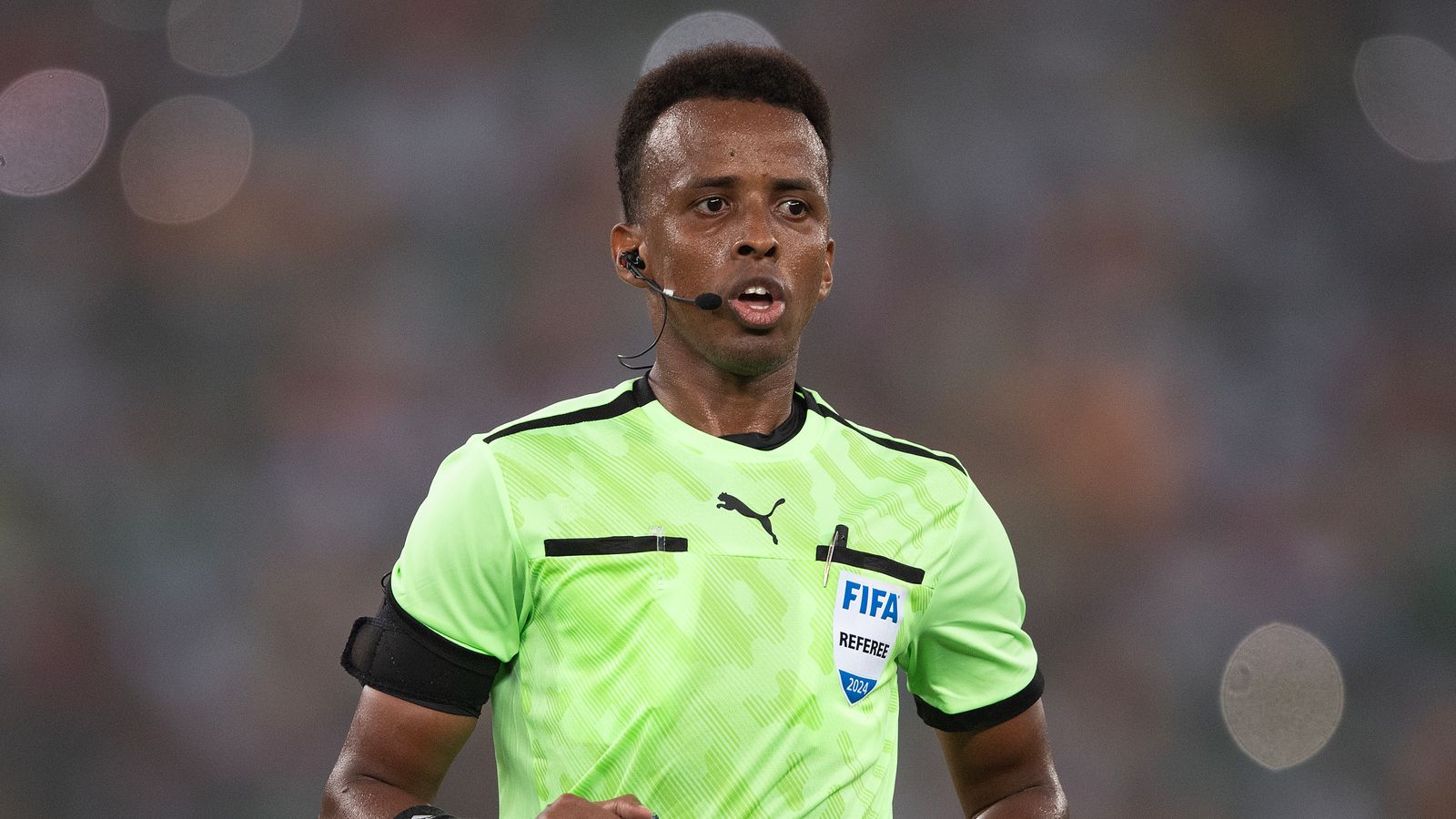
In one of the most shocking and widely condemned decisions in the build-up to the 2026 FIFA World Cup, Omar Artan Africa’s finest referee, the CAF Referee of the Year for 2025, and a man who was set to make history as the first Somali ever to officiate at a men’s World Cup has been unceremoniously stripped of his place in the tournament after being denied entry into the United States on the grounds of “vetting concerns.”
Artan arrived at Miami International Airport on Saturday June 7 from Istanbul with what he believed to be a valid US visa to work at the tournament. He was subjected to additional inspection by US Customs and Border Protection officers, declared inadmissible, and put on a return flight to Istanbul his World Cup dream ended at the immigration desk of an American airport. For football fans across Kenya, Somalia, and the entire African continent, this is a story of extraordinary injustice at the world’s most watched sporting event.
📋 Omar Artan — Key Facts
- Full name: Omar Abdulkadir Artan
- Age: 34
- Nationality: Somali
- Born: Mogadishu, Somalia, 1992
- FIFA-listed referee since: 2018
- Award: CAF Male Referee of the Year 2025
- Historic first: First Somali to referee at AFCON (January 2024)
- World Cup status: One of 52 selected FIFA World Cup 2026 referees — now dropped
- Reason for denial: “Vetting concerns” — US Customs and Border Protection
- Somalia’s status: On the US travel ban list
What Happened: How Omar Artan Was Turned Away at Miami International Airport
The sequence of events that ended Omar Artan’s World Cup dream unfolded with brutal swiftness. Artan flew from Istanbul to Miami International Airport on Saturday June 7, arriving as one of 52 FIFA-selected referees for the 2026 World Cup officials drawn from every confederation around the globe to officiate at the tournament being co-hosted across the United States, Canada, and Mexico.
At the airport, Artan was pulled aside by US Customs and Border Protection (CBP) officers for what the agency described as “additional inspection” a routine process, they noted, applied when officers need to verify information or determine admissibility. What followed was not routine. After the inspection concluded, CBP determined that Artan was “inadmissible due to vetting concerns” and denied him entry into the country. No further details were provided.
Artan was placed on a return flight to Istanbul. FIFA confirmed his removal from the tournament the following day, Monday June 9, in a terse official statement that acknowledged the situation without offering any challenge to the US government’s decision.
Did Omar Artan have a valid US visa?
This is one of the most confusing and troubling aspects of the entire situation. Artan believed he had a valid visa to work in the United States for the duration of the World Cup. His arrival at Miami Airport rather than being stopped before boarding strongly suggests that documentation had been issued or cleared at an earlier stage. The decision to deny him entry only after he physically arrived in the country, after what was described as “additional inspection,” has raised serious questions about the consistency and transparency of US immigration enforcement in the context of a major international sporting event.
Who Is Omar Artan? The African Referee Who Was Making History
To fully understand the magnitude of what has been lost not just for Artan personally, but for African football and for the principle of meritocracy in sport it is essential to understand exactly who Omar Artan is and what his selection for the World Cup represented.
Born in Mogadishu in 1992, Artan grew up in a country whose football infrastructure had been devastated by decades of civil conflict and instability. Somalia’s footballing landscape faced enormous challenges that made producing any internationally recognised official, let alone a world-class one, an extraordinary achievement. Artan became a FIFA-listed referee in 2018 the result of years of disciplined development supported by FIFA’s referee training programmes on the African continent.
His rise through the continental ranks was marked by a series of historic firsts. In January 2024, Artan became the first Somali referee ever to officiate at the Africa Cup of Nations overseeing the Group E match between Tunisia and Namibia. He went on to handle high-profile fixtures in the CAF Champions League, including the 2025/26 final second leg between AS FAR of Morocco and Mamelodi Sundowns of South Africa at Prince Moulay Abdallah Stadium in Rabat on May 24, 2026 just two weeks before the World Cup denial.
In 2025, Artan was named the CAF Male Referee of the Year the highest individual honor in African football officiating. He was also selected as one of the three African center referees at the 2025 FIFA U-20 World Cup, where he was the sole representative from Sub-Saharan Africa. His selection as one of 52 FIFA World Cup 2026 referees was the crowning achievement of a career that had overcome every obstacle Somalia’s difficult circumstances could place in his path.
What competitions has Omar Artan officiated?
Across his career, Artan has officiated in the Africa Cup of Nations, the CAF Champions League (including the 2025/26 final), the 2025 FIFA U-20 World Cup, and numerous international fixtures across the African continent. He is widely regarded by continental football administrators as one of the most technically accomplished and professionally rigorous referees Africa has produced in the modern era.
The Somalia Travel Ban: The Political Context Behind Artan’s Visa Denial
The denial of Artan’s entry cannot be understood without the political context that surrounds it. Somalia is currently on the United States travel ban list a policy that restricts or prohibits entry for nationals of designated countries, a measure that has been significantly expanded under the current US administration.
The travel ban context raises immediate and uncomfortable questions. Somalia is on President Donald Trump’s travel ban list, and the president has previously made inflammatory remarks about Somali immigrants in the United States. The application of travel ban restrictions to a FIFA-accredited World Cup referee a professional invited by the tournament’s governing body to fulfil an official technical role represents an extraordinary application of immigration enforcement that has no modern precedent in the history of World Cup officiating.
Crucially, Artan’s arrival in the US suggests that he had a valid visa prior to travel meaning his documentation had passed earlier scrutiny before the additional inspection at Miami Airport led to the final denial. The lack of any specific explanation beyond “vetting concerns” from CBP has made it impossible to assess whether the decision was based on any substantive security determination or on the blanket application of travel ban criteria to a Somali national.
FIFA’s Response: What the World Football Body Said and Did Not Say
FIFA’s official response to Artan’s exclusion was notable as much for what it did not say as for what it did. The world football governing body confirmed the situation in a brief statement that acknowledged the facts while carefully declining to criticize the US government’s decision in any terms.
“FIFA can confirm that match official Omar Abdulkadir Artan will be unable to train and officiate at the FIFA World Cup 2026 after he was denied entry into the United States. FIFA is not involved in host country immigration processes, including visa adjudications, and has been informed by authorities that Mr Artan’s status will not be changed at present. In line with previous FIFA events, a host government ultimately determines who receives a visa and who is admitted into their country.”
The statement is a masterclass in institutional neutrality technically accurate, diplomatically cautious, and entirely devoid of the moral clarity that this situation demands. By positioning the decision as simply a matter of host country sovereign immigration policy, FIFA has effectively absolved itself of any responsibility to advocate for one of its own officially accredited officials.
Should FIFA have done more to protect Omar Artan?
The global football community’s reaction to FIFA’s measured response has been largely critical. When a governing body selects 52 referees to officiate at its most important tournament, it implicitly takes on a duty of care towards those officials. The question of whether FIFA should have secured stronger immigration guarantees from the US government before awarding co-hosting rights to a country with active travel bans affecting multiple nations is one that will define the political legacy of this World Cup long after the final whistle.
Global Outrage: How the Football World Responded to Artan’s Exclusion
The football community’s reaction to Artan’s denial of entry was swift, unified, and deeply critical. From African football administrators to global sports journalists, the consensus was the same: a profound injustice had been done to a man who had earned his World Cup place entirely on merit.
Ciise Aden Abshir, a senior adviser to Somalia’s Ministry of Youth and Sports and a former national team captain, delivered the most direct public condemnation in a statement to AFP: “Omar is among Africa’s most respected referees and deserves the support of the entire football community. Denying him entry and preventing him officiating harms not only him personally but also undermines football’s commitment to fairness, merit and the spirit of fair play.”
The Somali government’s statement framed the denial not merely as a personal setback for Artan but as a direct attack on the foundational principles of sport the idea that achievement, professionalism, and merit should be the sole criteria for participation at the highest level. Those principles, the statement implied, had been subordinated to political immigration policy in the most visible sporting arena on the planet.
For football fans across Kenya and the broader East African region, this story carries particular weight. The exclusion of Africa’s best referee from the World Cup on the grounds of his nationality, despite his undeniable credentials touches directly on the broader conversation about how African sporting excellence is valued and protected on the global stage.
Artan Speaks: The Referee’s Own Dignified Response to an Undignified Decision
In the face of a ruling that would have devastated many, Omar Artan responded with remarkable dignity and composure. His personal statement, released on Monday June 9, was a model of professionalism that stood in stark contrast to the political machinery that had denied him his place in history.
“Despite the circumstances, I am in a positive mood and I am focused on the next challenges in my refereeing career. I would like to thank FIFA and the African federation for all their support and I promise to keep my refereeing levels up as I concentrate on the future. I want to thank the football family for their messages and wish my colleagues all the best success during the World Cup and I look forward to joining them again in future competitions.”
The statement is extraordinary in its grace. A man who was set to make history as the first Somali referee at a World Cup denied that honor at an airport immigration desk chose to focus on the future rather than the injustice. His promise to “keep my refereeing levels up” and his wish of “all the best success” to the colleagues who will now officiate without him speaks to a character and professionalism that the US immigration system’s “vetting concerns” could never have measured.
A Bigger Problem: Iran, Other Nationals & the World Cup’s Growing Visa Crisis
Artan’s case is not an isolated incident. It is the most high-profile manifestation of a wider visa and immigration crisis that is casting a growing shadow over the 2026 World Cup’s claim to be a truly global celebration of football.
Iran’s national team has had to establish its base in Mexico due to visa issues. The players are allowed to arrive in the US to play their matches, but must then return to Mexico between games. Several staff members were denied US visas altogether. The situation has created a logistical and diplomatic absurdity a national team competing in a World Cup that cannot fully reside in the country hosting the tournament.
There is also growing concern about federal agents harassing foreign nationals attending the tournament a development that has prompted warnings from several national football federations to their travelling supporters about navigating US immigration at a time of heightened enforcement.
The cumulative picture is of a World Cup whose host nation’s immigration policies are in direct tension with the tournament’s founding principle: that football belongs to the world. When Africa’s best referee cannot enter the host country, when a national team must shuttle across an international border between games, and when travelling supporters face harassment the question of whether the 2026 World Cup’s US co-hosting rights were awarded with sufficient scrutiny of these risks becomes impossible to ignore.
For football fans across Kenya and Africa who will be watching every match of the tournament from afar, Omar Artan’s story is a reminder that sport does not exist in a political vacuum and that the fight for African representation and respect at the highest levels of the global game is one that extends far beyond the pitch.
Frequently Asked Questions: Omar Artan World Cup 2026 Visa Denial
Why was Omar Artan denied entry to the United States?
US Customs and Border Protection stated that Omar Artan was denied entry after undergoing additional inspection at Miami International Airport and being “determined to be inadmissible due to vetting concerns.” No specific reason was provided. Somalia Artan’s country of nationality is currently on the US travel ban list, which is widely cited as the underlying factor in the decision.
Who is Omar Artan?
Omar Artan is a 34-year-old Somali referee born in Mogadishu in 1992. He became a FIFA-listed referee in 2018, made history in January 2024 as the first Somali to officiate at the Africa Cup of Nations, and was named the CAF Male Referee of the Year in 2025. He was selected as one of 52 referees for the 2026 FIFA World Cup before his visa denial removed him from the tournament.
What did FIFA say about Omar Artan’s exclusion from the World Cup?
FIFA confirmed Artan’s exclusion in an official statement, saying he “will be unable to train and officiate at the FIFA World Cup 2026 after he was denied entry into the United States.” FIFA stated it is not involved in host country immigration processes and that the US government’s decision would not be changed. The statement made no criticism of the US authorities’ ruling.
Was Omar Artan the only referee affected by US visa issues at the 2026 World Cup?
Artan is the most prominent individual affected, but he is not alone. Iran’s national team has been required to base itself in Mexico due to US visa restrictions, with several staff members denied visas altogether. Growing concerns about immigration enforcement affecting tournament participants and supporters have made the visa situation one of the major off-field stories of the 2026 World Cup.
What did Omar Artan say after being denied entry to the US?
Artan released a dignified personal statement in which he said: “Despite the circumstances, I am in a positive mood and I am focused on the next challenges in my refereeing career.” He thanked FIFA and the African football federation for their support and wished his referee colleagues success at the tournament, pledging to “keep my refereeing levels up as I concentrate on the future.”
What does Artan’s exclusion mean for African representation at the World Cup?
Artan was set to become the first Somali referee in World Cup history — a milestone that would have represented the culmination of Somalia’s remarkable football development journey despite decades of civil instability. His exclusion means Sub-Saharan Africa loses its most accomplished referee at the tournament, and his replacement will not carry the same historic significance. Somalia’s sports ministry described the denial as undermining “football’s commitment to fairness, merit and the spirit of fair play.” For the full official World Cup referee list and updates, visit the FIFA official website.