🇰🇪 Kenya's #1 Betting Tips & Sports News Blog
✈ TELEGRAM TIPS CHANNEL SIGN UP NOW →
JetBet Blog
England vs Croatia 4-2: How Squad Depth Won the Group L Opener
Home Analysis England vs Croatia 4-2: How Squad Depth...

England vs Croatia 4-2: How Squad Depth Won the Group L Opener

AL
By Alex Njoroge  ·  June 18, 2026  ·  6 min read

The World Cup 2026 Group L opener at Dallas Stadium delivered a six-goal thriller that lived up to its heavyweight billing. The 4-2 scoreline captured an entertaining, end-to-end contest – but the underlying mechanics told a deeper story for the rest of the tournament. Both sides flashed elite qualities, yet it was England’s balance and squad depth that ultimately separated them from Croatia and from the competition’s traditional giants.

Under the Texas lights, Thomas Tuchel’s World Cup bow with England suggested the Three Lions currently own the most structurally complete squad in international football. Where other contenders lean on uncertain systems or single-player dependencies, England showed a fluid, well-equipped identity capable of adapting to any crisis on the fly.

England vs Croatia: goals and timeline

MinScorerTeamScore
10′Harry Kane (pen)England1-0
35′Martin BaturinaCroatia1-1
41′Harry KaneEngland2-1
45+’Petar MusaCroatia2-2
47′Jude BellinghamEngland3-2
84′Marcus RashfordEngland4-2
The World Cup 2026 Group L opener at Dallas Stadium delivered a six-goal thriller that lived up to its heavyweight billing. The 4-2 scoreline captured an entertaining, end-to-end contest – but the underlying mechanics told a deeper story for the rest of the tournament. Both sides flashed elite qualities, yet it was England’s balance and squad depth that ultimately separated them from Croatia and from the competition’s traditional giants.
Under the Texas lights, Thomas Tuchel’s World Cup bow with England suggested the Three Lions currently own the most structurally complete squad in international football. Where other contenders lean on uncertain systems or single-player dependencies, England showed a fluid, well-equipped identity capable of adapting to any crisis on the fly.
England vs Croatia: goals and timeline
Min Scorer Team Score
10' Harry Kane (pen) England 1-0
35' Martin Baturina Croatia 1-1
41' Harry Kane England 2-1
45+' Petar Musa Croatia 2-2
47' Jude Bellingham England 3-2
84' Marcus Rashford England 4-2

First half: the sides inch apart
Tuchel raised eyebrows with his selection, handing flank starts to relative international newcomers Noni Madueke and Anthony Gordon while leaving Bukayo Saka and Marcus Rashford on the bench. In a fluid 4-2-3-1, England aimed to use that explosive wide pairing to stretch Croatia’s defence and open channels for Jude Bellingham to attack from deep.
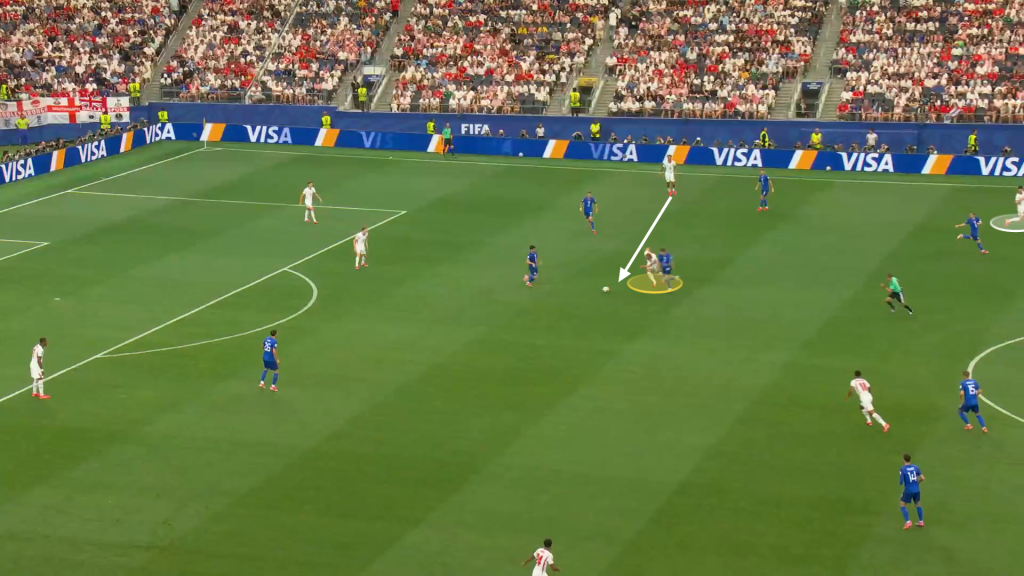
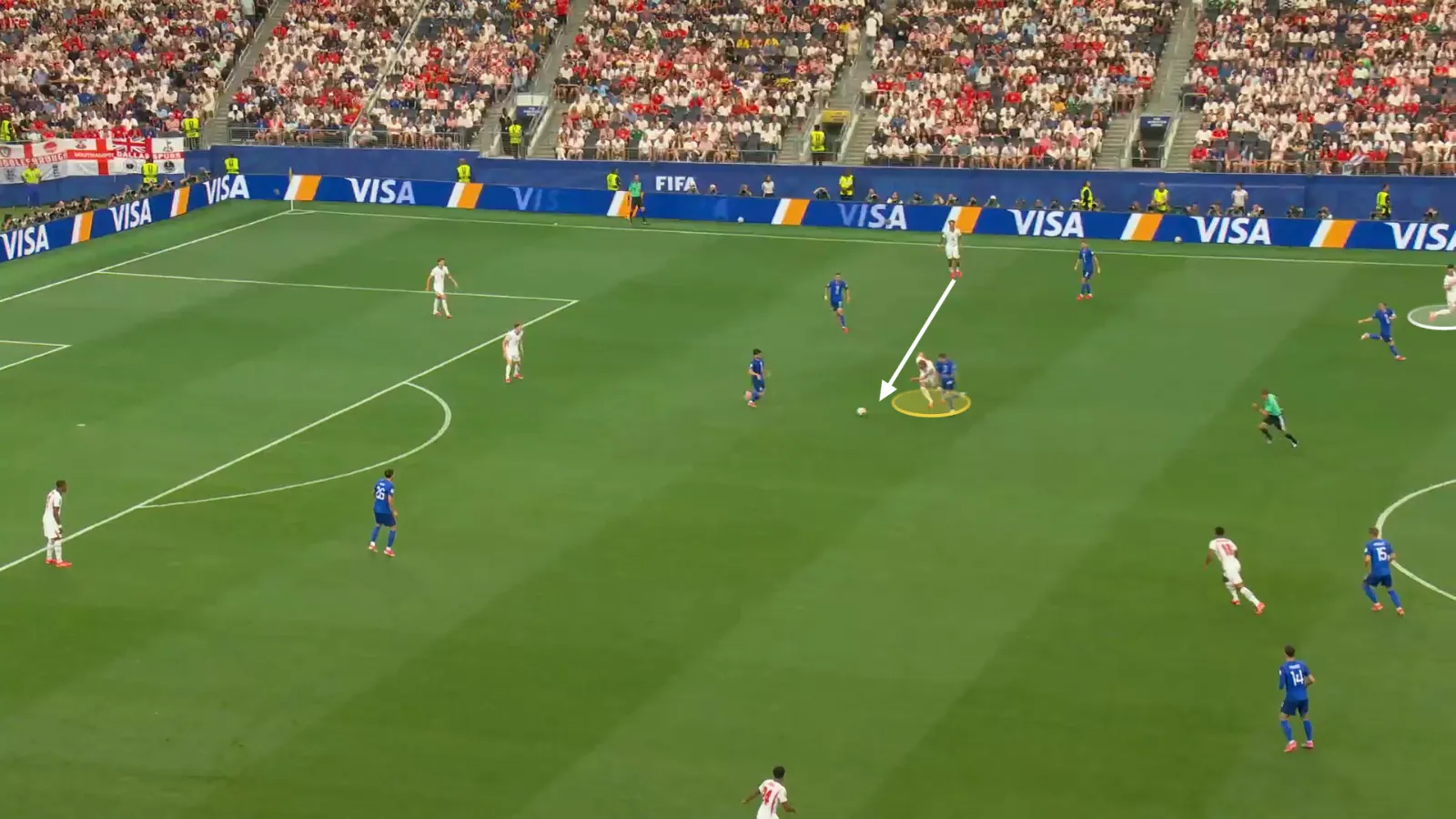
It paid off immediately. In the 10th minute, Madueke’s aggressive overlapping run forced an isolated Croatian backline into a rushed challenge in the box. After a VAR check, England were awarded a penalty; Harry Kane’s initial effort was disallowed and ordered to be retaken, but he made no mistake second time, tucking it into the bottom-left corner.
Croatia, though, are tournament veterans who rarely fold under early pressure. Set up in a flexible 3-4-3 and orchestrated by Zlatko Dalić, they used midfield composure to play through England’s first line. With Luka Modrić pulling strings deep alongside the young Petar Sučić, Croatia steadily manipulated the double pivot of Declan Rice and Elliot Anderson. In the 35th minute the patience paid off: Sučić found a pocket behind Rice and fed Martin Baturina, who turned sharply and fired past Jordan Pickford to level.
The game became an attacking showcase. England struck back in the 41st minute when Rice floated a magnificent looping cross that Kane met with predatory precision for his second. Yet Croatia’s resilience held: deep in stoppage time a rapid combination caught England’s centre-backs out of shape, and Petar Musa slipped a calculated low finish home. At 2-2, the half ended as a fascinating stalemate – but the physical cost of Dalić’s intensive system was about to be tested by England’s depth.
Second half: the power of personnel adaptability
England made an immediate statement. Less than two minutes after the restart, Bellingham showed why he is the heartbeat of the side: sensing a gap between Croatia’s midfield and back three, he surged from deep, took a subtle pass from Kane and drilled a ferocious effort past Dominik Livaković to make it 3-2.
With the lead restored, Tuchel’s squad management took over. Reading that Croatia’s midfield was tiring – underlined by Dalić withdrawing Modrić for Mateo Kovačić in the 57th minute – he moved to exploit England’s superior bench. In a 71st-minute triple change that would be the envy of any manager on the planet, England sent on Bukayo Saka, Marcus Rashford and Morgan Rogers together. The injection of fresh, world-class talent broke Croatia’s defence.
The variation was striking. Rather than dropping into a passive low block to protect a slender lead, England’s fresh legs sustained an intense high counter-press. Croatia were suffocated in their own third, unable to establish clean transitional lanes to Musa or substitute Andrej Kramarić. The knockout blow landed in the 84th minute: Saka won the ball in the middle third and slid a progressive pass to Rashford, who used his pace to cut inside from the left, leave his marker trailing and curl an unstoppable strike into the far corner for 4-2.
Why England stand above the giants
France, Argentina and Brazil all impressed in their openers, but each showed single-point vulnerabilities. Argentina remain heavily reliant on Lionel Messi’s creative hub; France can look isolated if Kylian Mbappé is squeezed out of wide areas; and Brazil often lack defensive stability when their full-backs push high.
England’s display in Dallas suggested none of those structural flaws. Tuchel has built a machine that not only tolerates rotation but thrives on it. Losing the lead twice, adjusting their pressing lines at the break, then introducing players of Saka and Rashford’s calibre to dictate the final twenty minutes points to an unmatched depth of resources.
Defensively, despite conceding twice to an efficient Croatian frontline, the John Stones–Ezri Konsa partnership looked organised under sustained pressure. In midfield, Rice provided an elite defensive screen, covering the ground that allowed Bellingham total freedom to operate as a shadow striker.
Croatia’s outlook: a strong foundation moving forward
Despite the defeat, Croatia showed exactly why they remain a formidable side capable of another deep run. Dalić’s first-half plan was excellent – the way they manipulated wide spaces and used Musa to disrupt England’s central pairing reflected a clear, coherent idea.
Baturina’s final-third performance proved Croatia have the technical quality to replace the creative output of their ageing golden generation. Even while chasing the game late on, they kept their discipline, shifting into a compact block that denied England further damage on the break. In tournament terms, scoring twice against a defence like England’s shows they have the firepower and maturity to handle the rest of Group L.
Frequently asked questions
What was the score in England vs Croatia?
England beat Croatia 4-2 in their World Cup 2026 Group L opener in Dallas, with goals from Harry Kane (2), Jude Bellingham and Marcus Rashford.
Why did Tuchel leave out Saka and Rashford?
Tuchel started Noni Madueke and Anthony Gordon to stretch Croatia’s defence early, then used Saka and Rashford as game-changers from the bench – a plan that worked when his 71st-minute triple substitution swung the match.
Who scored for Croatia against England?
Martin Baturina equalised in the 35th minute and Petar Musa made it 2-2 in first-half stoppage time before England pulled away in the second half.
What does the result mean for England’s World Cup hopes?
It signalled that England’s squad depth and tactical flexibility may set them apart from rivals such as France, Argentina and Brazil, who showed more single-player dependencies in their openers.
First half: the sides inch apart

Tuchel raised eyebrows with his selection, handing flank starts to relative international newcomers Noni Madueke and Anthony Gordon while leaving Bukayo Saka and Marcus Rashford on the bench. In a fluid 4-2-3-1, England aimed to use that explosive wide pairing to stretch Croatia’s defence and open channels for Jude Bellingham to attack from deep.

It paid off immediately. In the 10th minute, Madueke’s aggressive overlapping run forced an isolated Croatian backline into a rushed challenge in the box. After a VAR check, England were awarded a penalty; Harry Kane’s initial effort was disallowed and ordered to be retaken, but he made no mistake second time, tucking it into the bottom-left corner.

Croatia, though, are tournament veterans who rarely fold under early pressure. Set up in a flexible 3-4-3 and orchestrated by Zlatko Dalić, they used midfield composure to play through England’s first line. With Luka Modrić pulling strings deep alongside the young Petar Sučić, Croatia steadily manipulated the double pivot of Declan Rice and Elliot Anderson. In the 35th minute the patience paid off: Sučić found a pocket behind Rice and fed Martin Baturina, who turned sharply and fired past Jordan Pickford to level.

The game became an attacking showcase. England struck back in the 41st minute when Rice floated a magnificent looping cross that Kane met with predatory precision for his second. Yet Croatia’s resilience held: deep in stoppage time a rapid combination caught England’s centre-backs out of shape, and Petar Musa slipped a calculated low finish home. At 2-2, the half ended as a fascinating stalemate – but the physical cost of Dalić’s intensive system was about to be tested by England’s depth.

Second half: the power of personnel adaptability

England made an immediate statement. Less than two minutes after the restart, Bellingham showed why he is the heartbeat of the side: sensing a gap between Croatia’s midfield and back three, he surged from deep, took a subtle pass from Kane and drilled a ferocious effort past Dominik Livaković to make it 3-2.

With the lead restored, Tuchel’s squad management took over. Reading that Croatia’s midfield was tiring – underlined by Dalić withdrawing Modrić for Mateo Kovačić in the 57th minute – he moved to exploit England’s superior bench. In a 71st-minute triple change that would be the envy of any manager on the planet, England sent on Bukayo Saka, Marcus Rashford and Morgan Rogers together. The injection of fresh, world-class talent broke Croatia’s defence.

The variation was striking. Rather than dropping into a passive low block to protect a slender lead, England’s fresh legs sustained an intense high counter-press. Croatia were suffocated in their own third, unable to establish clean transitional lanes to Musa or substitute Andrej Kramarić. The knockout blow landed in the 84th minute: Saka won the ball in the middle third and slid a progressive pass to Rashford, who used his pace to cut inside from the left, leave his marker trailing and curl an unstoppable strike into the far corner for 4-2.

Why England stand above the giants

France, Argentina and Brazil all impressed in their openers, but each showed single-point vulnerabilities. Argentina remain heavily reliant on Lionel Messi’s creative hub; France can look isolated if Kylian Mbappé is squeezed out of wide areas; and Brazil often lack defensive stability when their full-backs push high.

England’s display in Dallas suggested none of those structural flaws. Tuchel has built a machine that not only tolerates rotation but thrives on it. Losing the lead twice, adjusting their pressing lines at the break, then introducing players of Saka and Rashford’s calibre to dictate the final twenty minutes points to an unmatched depth of resources.

Defensively, despite conceding twice to an efficient Croatian frontline, the John Stones–Ezri Konsa partnership looked organised under sustained pressure. In midfield, Rice provided an elite defensive screen, covering the ground that allowed Bellingham total freedom to operate as a shadow striker.

Croatia’s outlook: a strong foundation moving forward

Despite the defeat, Croatia showed exactly why they remain a formidable side capable of another deep run. Dalić’s first-half plan was excellent – the way they manipulated wide spaces and used Musa to disrupt England’s central pairing reflected a clear, coherent idea.

Baturina’s final-third performance proved Croatia have the technical quality to replace the creative output of their ageing golden generation. Even while chasing the game late on, they kept their discipline, shifting into a compact block that denied England further damage on the break. In tournament terms, scoring twice against a defence like England’s shows they have the firepower and maturity to handle the rest of Group L.

Frequently asked questions

What was the score in England vs Croatia?

England beat Croatia 4-2 in their World Cup 2026 Group L opener in Dallas, with goals from Harry Kane (2), Jude Bellingham and Marcus Rashford.

Why did Tuchel leave out Saka and Rashford?

Tuchel started Noni Madueke and Anthony Gordon to stretch Croatia’s defence early, then used Saka and Rashford as game-changers from the bench – a plan that worked when his 71st-minute triple substitution swung the match.

Who scored for Croatia against England?

Martin Baturina equalised in the 35th minute and Petar Musa made it 2-2 in first-half stoppage time before England pulled away in the second half.

What does the result mean for England’s World Cup hopes?

It signalled that England’s squad depth and tactical flexibility may set them apart from rivals such as France, Argentina and Brazil, who showed more single-player dependencies in their openers.
Found this helpful? f Facebook ✈ Telegram
AL
Alex Njoroge
✍️ JetBet Blog Tipster
Expert betting analyst and tipster at JetBet Blog Kenya. Providing data-driven predictions and match previews updated daily.
View All Posts →

Leave a Comment